

The year is 2008, and you are a gamer. As both a business and a burgeoning art form, video games have never been bigger. The seventh console generation has arrived, and with it come promises of unprecedented computing power, near-photorealistic graphics, and the barely touched frontier of online play. Yet you’ve also started to realize that with scale doesn’t always come quality.
Gone are the tight platformers of the Super Nintendo and the charming polygonal jank of the Playstation 1. To keep up with the market, the same two dozen companies churn out versions of the same military shooters and medieval roleplaying games year after year, always in some shade of grey. (Yellowish grey, for Middle East-coded levels; blue-ish, for the ex-Soviet ones; and for the occasional fan of a more radioactive hue, there are even a few greenish grey ones, too.) With newfound pop culture ubiquity, video games have become mundane. There are no moral panics about virtual violence. Your thirty-year-old brother watches Blu-Rays on his PS3. Your grandma works out with a Wii.
Yet right when this stagnation seems to be reaching a tipping point, there’s a light at the end of the tunnel. A bunch of goofy-haired, thick-lensed Millennials have arrived to disrupt the industry. Enter indie games. Armed with increasingly complex PC development tools like Unity and online distribution platforms like Steam, these indie developers argue that anyone can make a videogame.1The impact of these technologies was not limited to the indie space. Licensable engines in particular revolutionized the speed in which AAA development studios (and artists in other industries, such as film) could design and manipulate 3D models and spaces with simulated physics. For a look at how Epic Games’ Unreal Engine has exploded over the past two decades, check out Anna Weiner, “How Perfectly Can Reality Be Simulated?” in The New Yorker (April 15, 2024).2 And in sharp contrast with the hackers and homebrewers that characterized the hobbyist scene of the 80s and 90s, they can even make money off it, too.
2012’s Indie Game: the Movie3James Swirsky and Lisanne Pajo, Indie Game: The Movie (2012), Blinkworks Media is a time capsule of this era. The documentary closely follows three independent development teams in the lead-up to the launches of projects to which they’ve each devoted years of full-time work and a not unsubstantial amount of personal wealth. And for which, as it turns out, each dev will become famous: in something of a chicken-or-the-egg scenario, all three games featured are, even today, considered definitive touchstones of indie gaming. Jonathan Blow’s Braid is a deceptively simple side-scrolling puzzler that takes a familiar gaming conceit (the ability to rewind time) and pushes it to brain-bending extremes. Super Meat Boy – a brutal platformer where dying over and over again in bursts of bright, pixelated blood is the point – single-handedly created the “splatformer” subgenre. And while Fez is another seemingly innocuous puzzler, devoted fans spent years diving down the rabbit hole of its many secrets, in the process turning the game into a sort of deconstruction of what video games are even supposed to be. It’s one of the earliest examples of what the gaming critic Mark Brown has dubbed “knowledge-based games”: what Fez demands from the player has less to do with their skill or endurance than with curiosity and outside-the-box thinking. Some particularly devious puzzle solutions required cracking cyphers, manually changing system settings like time and date, and even data-mining the game’s source code.
Along with a few other hits – notably, pre-Microsoft-acquisition Minecraft – these titles were among the first independently developed and distributed games to truly break out in the modern era. Some one- and two- person production teams were taking home seven-figure payouts from royalties alone. Bloggers, critics, and industry insiders were calling it an Indie Renaissance: this democratically available tech, so the story goes, would upend the market and let high-quality, low-overhead projects dethrone the umpteenth Call of Duty sequel.
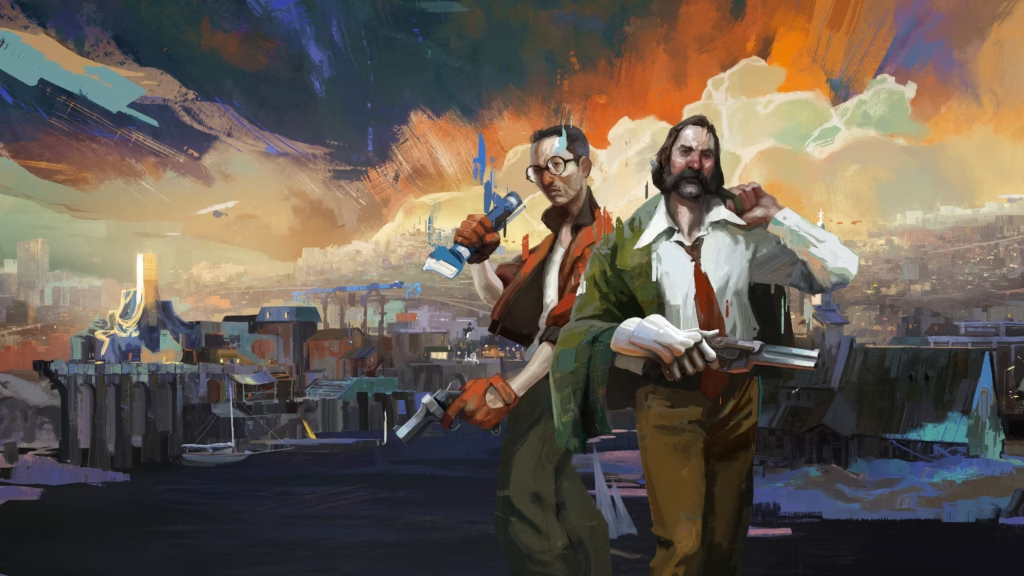
Fifteen years later, and it’s clear this is not what came to pass. While indie games have become undeniably more visible since 2010 – with all three major console companies plus Steam promoting dedicated “indie” showcases – the actual products being sold are not nearly so exciting. Though there are still occasional indie breakouts that offer a glimmer of hope, the genuine innovation of a masterpiece like Disco Elysium has become the exception rather than the rule. Among those indie games popular enough to be familiar names among the average gamer, things feel eerily similar. It all becomes one big Silicon Valley pitch deck. Hades is The Binding of Isaac with Greek gods. Celeste is Super Meat Boy if it cared about your mental health. Even my – and many critics’ – favorite titles from 2024 are guilty of this “x meets y with the art style of z” mentality. Balatro adds roguelike elements to the rules of poker. And Animal Well is just Fez except, well, worse.
And these are the good ones! The less discussed flipside to the democratization of development tools is the reality that many of the ensuing products will inevitably suck. Even the digital storefronts that are supposedly reserved for professional, commercial releases are flooded with junk of various kinds: half-assed tech demos, fetish porn games, and (increasingly) AI slop. Because there are none of the old chokepoints of physical media distribution, selling an indie game is now a matter of playing to the finicky concerns of influencers and algorithms. Success cascades exponentially into more success; meanwhile, according to Steam’s internal reports, over 90% of indie games never sell more than 5,000 copies. (Though on the other hand, these numbers would still make a small press book publisher salivate.)
The fact that the market is undeniably saturated hasn’t stopped companies big and small from throwing capital at supposedly “indie” teams. Much like the movies and music of the 1990s, genuinely independent productions have gradually been supplanted by a cottage industry of “indie publishers” structured as semi-autonomous imprints within the very corporate structures indie developers were supposed to have rejected and defied. Having carefully curated their lists, these publishers quickly sign contracts with solo and small-team developers whose vision (usually quirky, extremely violent, or both) aligns with the company’s brand identity or its marketing strategy towards some target demographic. And while more funding isn’t necessarily a bad thing, an influx of outside money can often lead to development issues – notably scale. In her book Everything to Play For, the leftish games writer Marijam Did explores how larger industry concerns about development crunch trickle into the indie space, too. Did sees the narrative of indie developers being in opposition to “the man” of Triple-A gaming, of how they do it all for the art, as having led to their work conditions to become “romanticized.”4Marijam Did, “Level IV: Modes of Production” in Everything to Play For: How Videogames are Changing the World, 178-216 (2024), Verso Books. I reviewed Did’s book earlier this year for the literary magazine Mid Theory Collective. (“Too Much Industry” by Martin Dolan, January 16,2025). While Did’s book is useful in that it foregrounds the very real human/labor cost of the gaming world, I took issue with how her materialist critique ignored the aspect of “games” that people enjoy – the fun. At risk of tooting my own critical horn, I think this quote from my review is as good a summary as any of the issue:
For all her (valuable) materialist critiques of abusive industry practices, of corporate-mandated misguided swings at diversity, of connections between gamers and defense contractors and military groups, Everything to Play For has next to no critical analysis of games themselves.
This romance obscures the business-end reality of running a media company on tight margins – low salaries for employees, job insecurity, and the need for everyone on the team to work beyond their job description, doing ad hoc marketing and publicity on top of their everyday duties.5The same sorts of issues arise for titles with publishers and distributors, too. Last year, Jason Schrier at Bloomberg.com reported on the internal drama at Annapurna Interactive, the arty video game distribution arm of a billion dollar media company (“Annapurna Video-Game Division Imploded Because of Power Struggle,” September 27, 2024). After years of flirting with bankruptcy while publishing beloved indie titles like Outer Wilds and What Remains of Edith Finch, the entire 25-person team of the imprint walked out of their jobs, leaving the future of the company’s already-signeddistribution deals for 2025 and 2026 up in the air. Much of this boils down to the small scale of indie studios, which have only a handful of full-time employees. This means that when projects inevitably balloon in scale, work gets offloaded to freelancers and contractors. Needless to say, the ethos of ownership does not usually extend to hired help.
So while indie games might still superficially scan as a refreshing alternative to mainstream franchises like Call of Duty and Madden, the same business practices trickle down the industry even as the number of A’s decreases. In the “pitch” stage, for instance, there are increasingly similar preoccupations determining what gets the green light from a game’s financial backers. Even in indies, a preoccupation with IPs reigns, as do pressures from above to make all new games feel like some previous success. Take Stardew Valley. That title was among the first in a resurgence of “cozy games” – slower-paced, usually female-coded projects featuring farming mechanics and slice-of-life elements. A crop of overripe imitators quickly sprouted. Today the cozy space has widened to include what are functionally digital chores – Unpacking, Cozy Grove, A Short Hike, and the like.
As with American indie art of every medium, the tyranny of twee quirkiness reigns supreme. The most blatant offenders are the disproportionately visible swath of titles that feel like the gaming equivalents of Oscar Bait.6For a satirical attack by two of our editors on the analogous trend in literary fiction, see Max Ornstein & John Michael Colón, “Pulitzer Bait” in Strange Matters Issue Three (Spring 2024). –Eds. These are games that use their art direction and their minimalist mechanics to gesture towards a thematic profundity that’s not really there. Their main progenitor, Journey, seemed beautiful upon its 2012 release, inspiring a mass of think pieces about “games as art.” But in the ten-plus years since, entire companies have eked out a living aping its beats. PlayDead’s Inside and Limbo are all art direction, no substance. Gris is gorgeous but not particularly fun to play. Despite the paper I wrote in grad school about it illuminating “nonlinear indigenous ways of knowing,” Never Alone is at the end of the day a run-of-the-mill puzzler that just happens to have an Inuit protagonist (and panel of consultants behind it). And Moon Studios, the team behind the Ori games (and now folded into Microsoft), spent the 2010s retreading mechanics that Super Metroid already perfected thirty years ago. It’s the same game, only set to a swelling orchestra and not an ambient MIDI soundscape – music that was composed, one gets the sense, in anticipation of its being the soundtrack for a Game Awards acceptance speech.
If video games are, as their fiercest critics do still contend, infantilizing and vaguely fascist toys (Malcom Harris, consider this my invitation to debate), then these award-bait titles are analogous to the stuff you’d find at the Parent-Teacher Store. Eighty-dollar, ethically sourced Lincoln Log dupes – marketed to parents with good taste, liberal guilt, and a superiority complex. In other words, not really revolutionary at all.
~
I’m being facetious here, a little. For those who know where to look, there are certainly still exciting projects being created in the indie space. Diamonds abound in the rough, especially for fans adventurous enough to dip their toes into the development side of things, pulling work-in-progress demos off community forums, itch.io, and Steam Early Access.7A fantastic example of this is Freehold Games’ Caves of Qud. The game, which is an ASC-II-inspired RPG with a mind-bogglingly complex set of interlocking systems, has existed in various states of pre-release for nearly 20 years. Development started in 2007, during the first heyday of indie games, and went to Beta in 2010. In
2015, it became one of the first adopters of Steams’ Early Access program – where players could work through most of the game – though it wasn’t until 2024 that publisher Kitfox Games released the official version 1.0. For a great interview about Qud’s iterative and collaborative design process read developers Brian Bucklew and Jason Grinblat’s conversation with gamedeveloper.com (“Tapping into the potential of
procedural generation in Caves of Qud” by John Harris, March 10, 2022). It’s just depressing that for every one of these genuinely interesting new titles, there are dozens if not hundreds more Stardew Valley knockoffs or copy-paste nostalgia platformers to steal the buzz. And doubly so since, with even the biggest Triple-A development companies reeling from layoffs, it’s not unreasonable to imagine the indie scene’s days of being flush with cash are numbered.
But history is full of unexpected little twists. If the circa-2010 indie movement has a true successor – in terms of financial viability and infectious energy – it’s in the gaming culture that has gradually emerged around livestreaming. For those unfamiliar, this is the practice of broadcasting yourself playing a video game to a live audience. The audience can see both your face and the game in question on their screen, as well as interact with you in a live text chat that is also broadcast in real time. In his 2025 book Stream Big: The Triumphs and Turmoils of Twitch and the Stars Behind the Screen, gaming journalist Nathan Grayson tells the story of the first decade of Twitch, the once-ubiquitous streaming site that almost singlehandedly birthed a subculture. Evolving out of bizarre, Web 2.0 performance art-adjacent experiments with webcasting, Twitch was founded in 2011 as the gaming-specific arm of a larger livestreaming company called Justin.TV. But it turns out video games – with a tech-literate fan base already well versed in the elliptical language of memes – was a better fit for the nascent technology than Justin.TV’s reality show challenges. Twitch quickly became the company’s focus. Its viewer base grew steadily over the first part of the 2010s before Amazon reached into their bottomless pockets to acquire it in 2014. 2018 was when livestreaming as a phenomenon truly crossed over in the public consciousness. (Remember when Drake played Fortnite with Ninja, or a fish beat Pokemon Red?) By the time of the pandemic lockdown, streamers had become the most visible public figures in many young people’s lives, and Twitch suddenly had to deal with opposition from rival startups like Kick.com who wanted a piece of the pie.
While livestreaming’s sudden ubiquity came with some innovation, Grayson is careful to identify streamers themselves as the key to Twitch’s massive growth. He writes that “[where] YouTube could be likened to a nation with highways and bypasses crisscrossing between disparate states, Twitch is more like a city where all the major players know each other. Everybody uses the same lingo, references the same touchstones. Cameos [multiple streamers calling, visiting, or playing games with each other] are common, especially among top streamers. If all the creators and viewers
responsible left tomorrow, Twitch would no longer be Twitch.”8Nathan Grayson, “Introduction” and “Chapter 1: Community” in Stream Big: The Triumphs and Turmoils off Twitch and the Stars Behind the Screen 1-47 (2025), Atria Books
This is the mentality that allowed Twitch – and streaming culture in general – to explode among Gen Z in such a short time. The medium has also created a new kind of celebrity. Its teenage and twentysomething stars are larger-than-life screen presences and personalities, happily performing in-jokes day after day (for some professionals, for something like 200 hours per month) to their loyal, and paying, fans. Young gamers are as likely to know the names of the largest streamers as of the latest Hollywood couples – if not more.9There is an offshoot of livestreaming culture that evolved in a peculiar direction that may be of some interest to our readers. Initially mixing gaming with political commentary, some streamers eventually abandoned the former entirely for the latter. A streamer of this kind will instead broadcast live political debates with some opponent, or commentaries by the streamer upon political YouTube videos by other content creators, all with a sort of smug debate club sensibility that’s about scoring points, winning arguments, and not getting owned. This ecosystem coexists alongside political YouTube, and indeed many of that genre’s biggest personalities actually got their start as Twitch streamers. In many cases, their hour-long YouTube videos are edited down from multi-hour marathons on Twitch that take upwards of a quarter of a day to watch all the way through. Personalities as diverse as an establishment liberal and Zionist called Destiny, a self-described (but highly politically unreliable and sometimes downright reactionary) “libertarian socialist” called Vaush, and the red-brown fascist-Leninist called Haz have attracted hundreds of thousands or even millions of eyeballs totheir semi-informed rants and showdowns, and even drawn fans into their ideological fold. As the last example especially shows, this is concerning because streamer politics tends to be (a.) internally incoherent, drawing upon mutually exclusive elements that don’t in fact go together; (b.) cults of personality around the star; and (c.) completely divorced from reality, creating a sort of parallel universe sustained by the performance of the streamer. Yet for all this, such streamer politics has had a real-world impact. Haz is the founder of an incoherent cryptofascist political tendency, Patriotic Socialism or MAGA Communism, that is now organized into an actual political party called the American Communist Party that has aspired to make connections with far-right forces like the Trump administration domestically and the Putin regime abroad. Destiny was, bizarrely, invited to a four-person debate on Israel’s genocide of Gaza involving such serious historians and commentators as Norman Finkelstein, Mouin Rabbani, and Benny Morris – an absurd and obscene spectacle that was at once hilarious and disgusting. The video has 3.8 million views. This means that, even at a miniscule conversion rate, more people have sat through all five hours of that interminable video than have read Mason Herson-Horvath’s brilliant essay on Gaza in our online pages, or even heard of Strange Matters at all. A depressing thought, but one that is worth contemplating as the libertarian-socialist left continues to build not only its laboratory for generating ideas but its transmission belt for spreading them. –Eds.
10
But while Grayson spends his book talking about the tech and business innovations that led to Twitch’s rise, he glosses over an equally (if not more) important fact: if gaming culture created streaming as we know it, the opposite is also true. Today, the tastes of streamers and their fans have a disproportionately large impact on the development of games – especially in the crowded indie space, where thousands of tiny projects jostle for attention.
Hence the newfound prevalence of what I’ve come to think of as “streamer games.” These titles are unified less by genre or mechanics than by vibe – they’re designed to be played socially, whether within friend groups or broadcast on stream, and then reacted to by onlookers.11While this essay was in the process of being edited, a new term came to prominence in games journalism and social media: “friendslop.” It describes much the same phenomenon as Dolan’s “streamer games” – or at least, there is considerable overlap. We find this a pretty cool example of how ideas can just be “in the air”: when material conditions change, observant minds can easily experience the same shifts and call them by different names. –Eds. Many share DNA with the internet browser games Zoomers grew up on: mechanically simple, with quick rounds ideal for taking turns. They’re often deliberately rough around the edges, with low-poly graphics, goofy ragdoll physics, and intentionally maddening rage-bait fail states. Instead of demanding the brain power and reflexes that many modern games do, streamer games seem practically designed to be talked over and toyed with while multitasking. For all their gameplay-first design focus and meme-y sensibilities, the end result feels weirdly nostalgic – more akin to an afternoon at the arcade in 1985 than a full game release in 2025. Which is to say, they’re not exactly fine art. But in contrast to the unimaginative parade of copycat “prestige” games that have come to dominate people’s sense of what’s “indie,” they’re a breath of fresh air.
Take Among Us – the game that got us into this mess in the first place. For those reading who didn’t have a nine-year-old nephew squawking about it for all of these past few summers, it’s functionally an online party game riffing on meatspace summer camp classics like Mafia. When a session loads, players control a crew of spacemen running routine chores on their ship – plotting maps, re-running wires, nothing so complicated that it can’t be done with a swipe of a tablet screen. But on board there are also randomly-selected “imposters”: players who try to blend in with the rest of the crew before slinking away and murdering a few via button tap. Bodies are eventually found, reported, and, in a flurry of Discord unmuting, fingers are pointed at whom to blame. Losers of the resulting vote – i.e., anyone who has been acting “sus” – are booted from the spaceship Survivor-style. If an innocent is thrown out the airlock, the real murderer lives to kill another day.
One of the most visible examples of streaming culture’s takeover was when, in October 2020, a group of Twitch personalities led by lefty commentator Hasan Piker hosted representatives Alexandria Ocasio Cortez and Ilhan Omar for a few rounds of Among Us. The occasion was an elaborate get-out-the-vote campaign with gamers, Hasan fans, and other extremely online Zoomers as its target audience. And it was an extremely successful one: the resulting three-plus hour stream was, at the time, one of Twitch’s most viewed broadcasts. Watching it again for this essay, I can’t avoid feeling that AOC is a natural on stream. After a few bumpy minutes of learning the rules and where the mute/unmute button is on Discord, she’s quickly keeping up with the professional streamers. She smirks as she asks “chat” a question now and then. When she accidentally reports the body of a crewmate she’d killed, she hams up her fake surprise. In a touching (and telling) show of American Democratic Values (™), Omar refuses to vote AOC off the space ship even after she’s caught red-handed murdering Pokimane. “That’s my ride-or-die right there!” AOC says about Omar, as her avatar’s corpse is nevertheless ejected into the vacuum.12Grayson spends an entire chapter on Piker and his relationship with mainstream (meaning, outside of gaming) left media, especially this episode with Ocasio-Cortez and Omar. See “Chapter Nine: Solidarity” in Stream Big.
Among Us was released quietly in 2018, but it wasn’t until the pandemic – when watching Twitch streams started to emerge as an activity not just limited to super nerds – that it fully exploded. Its zany social gameplay was a perfect fit for homebound streamers who wanted something to collaborate on. But it was also a hit with regular people, not even gamers, since cross-platform connectivity made it so anyone with an iPhone could jump in a game. (I’ve heard horror stories of work-mandated Among Us rounds…) It’s telling that of all the games to choose from with followings on Twitch, the allegedly League of Legends-loving AOC should’ve picked Among Us. One suspects it was more than just the game’s tenuous connection to voting. If the tactics of high-level Dota play are as indecipherable to the uninitiated as those of professional football, if watching competitive Tekken is like seeing a savant shred an electric guitar, then games like Among Us are something refreshingly approachable by comparison – the game of I Spy you start spontaneously as you gaze out the car window on a road trip, the ghost stories you start whispering to each other around the camp fire. It’s less a finished product to experience or a challenge to overcome than an excuse to (digitally) hang out. A social game for a not-quite-social age.
Scrolling YouTube, there are literally uncountable variations of this same video. You can swap AOC and Omar for any influencer or VIP you wish. As “research,” I click on one titled “Kai Cenat and CaseOh Play Buckshot Roulette!” It’s a fifty-nine-minute clip of a longer Twitch stream. In it, two of the biggest internet celebrities (both probably unrecognizable if you’re over twenty-five) jump onto an impromptu Discord call to play a game that’s basically virtual Russian Roulette.13Official recordings of the stream have been clipped on two YouTube channels: “Kai Cenat and CaseOh Play Buckshot Roulette” on the Kai Cenat Live channel (November 19, 2024) and “Caseoh and Kai Play Buckshot Roulette” on CaseOh’s channel. (uploaded November 20). Watching clips of the same livestream from opposite perspectives is a perfect example of how streaming videogames, as a phenomenon, is mediated by the personalities on screen, and also how many gigabytes of the internet is filled with redundant uploads of slop-like content. A lot of what an ungenerous viewer might anticipate is there: the oversized headsets, the goofy gaming chairs, the rapid-fire nonsense questions directed at those in “chat!” as they offer advice. Both Cenat and CaseOh overreact to literally every single action happening in game, from stealing the others’ cigarettes to being shot point-blank in the face. They also audibly narrate everything on the stream as it happens (“gotta pick what item to use…”, “two blanks, two live…”) for viewers who might be as distracted as they are. The effect is a sort of streaming-pidgin – difficult for an outsider to decipher and borderline hypnotic.
But watching the whole stream, I can’t help but fall for its charm. The Buckshot Roulette game is, presumably, only a small slice of both Cenat and CaseOh’s all-day streaming schedule. But if they’re burnt out, they don’t show it. They manage to simultaneously play the game, talk trash, quip about other Twitch “current events,” and keep their chats (of tens of thousands of concurrent viewers) entertained. Could such a balancing act be managed if Cenat and CaseOh were queuing up in a public Warzone lobby? Maybe, but only because these guys are professionals. But Buckshot Roulette – with its over-the-top premise, pick-up-and-play mechanics, and ample downtime between rounds – seems tailor-made for these sorts of parasocial viewing experiences. Form influences function indeed.
Still, my critics may be unconvinced. After all, aren’t these so-called “streaming games” just the most recent examples of a phenomenon – intentionally janky couch co-op games – that have been around for decades? As much as they might want to believe otherwise, Zoomers on Twitch did not create “backseat gaming,” nor using video games as an excuse to hang out. The most ungenerous read would be that what’s going on here is nothing but a successful rebrand. After all, Among Us – developed in the mid-2010s when Twitch was gaining popularity but nowhere near as ubiquitous as it is now – is nothing so formally novel that it couldn’t have been included as a minigame on Mario Party for the Nintendo 64. Rather than innovation in the games themselves, we’ve seen marketing teams identify streaming as a growing force in the industry and create their own language to cater to that niche.14These companies – which offer truly independent developers services similar to what might be provided by a publisher or imprint–are a recent phenomenon. Their proliferation in the second half of the 2010s coincides, by my count, with when indie games started to feel more formulaic than revolutionary. After all, in the growing creator economy, if a product is viral enough, in the hands of enough interested people on Twitch and YouTube, it practically sells itself.
To the extent that I’m wary of letting tech companies like Twitch pat themselves on the back for “disrupting” a supposedly stagnant industry, I do think the streaming skeptics have a point. After all, many of the games that propelled Twitch to today’s level of popularity weren’t designed with it in mind. Fortnite’s innovation wasn’t so much in its streaming-friendly subject matter as in its willingness to steal other games’ 100-person Battle Royale format and its shameless incorporation of other IPs into its in-game store. And Among Us languished in obscurity for almost two full years before, somewhat randomly, it enjoyed an explosion of pandemic-induced virality.
But even if Twitch’s earliest hits owed more to back-end viral marketing efforts, post 2020 a growing crop of projects have undeniably been developed from the get-go with streaming – both on the player and viewer end – in mind. The best example of the streaming game as not only a pastime but a design philosophy is 2023’s viral hit Lethal Company. In a way, its conceit is similar to Among Us: you load into a lobby, ideally with a number of friends, and play as a group of indentured deep-space laborers tasked with gathering an ever-growing dollar quota’s worth of random scrap from what appear to be the ruins of former space colonies. Over a series of levels, your team descends onto the surfaces of abandoned moons to see what’s been left behind – mostly ad hoc collections of everyday junk – while avoiding waves of mutant spiders and other nightmarish creatures who try to kill you on sight.
As in Among Us, the sociality of Lethal Company is largely its point – but now, the understanding of this principle is baked into nearly every part of the game’s form. You’re welcome to try to load into a game solo, or with a randomly-assigned group of teammates, but you’d be experiencing the game only in its barest bones. The real fun isn’t in its janky survival horror mechanics (like hitting aliens with a dented stop sign, or having to choose between salvaging a rare generator or keeping the lights in the building on), but rather in stumbling through them together with friends.

at https://store.steampowered.com/app/224760/FEZ/.
Every one of Lethal Company’s most brilliant development choices are tiny design elements carefully tuned to escalating situations until they are as chaotic as possible, all because of your and your friends’ human error. This starts in the very first seconds of the game, when you realize the instructions are located diegetically on an in-game clipboard that one player must pick up and read aloud to the rest of the crew. There’s also a walkie-talkie that lets you communicate with other players across the map, but only if they’re holding one too – and you’d better hope they aren’t being a huge asshole and talking loud enough to give your location away. Then there’s the teleporter, which is helpful for getting everyone back to home base after a salvage run. But it’s also key to recovering the corpses of dead crewmates if, say, someone had to be left behind to sate the appetite of a stampeding monster – an important consideration if you’d like to reduce a monetary penalty from the company. (They couldn’t care less about the death or the corpse. But space suits are expensive!)
Lethal Company and the games it’s sure to inspire15Chief among them Peak,
developed jointly by the indie studios Aggro Crap and Landfall. When Peak released this June, after the initial draft of this essay was filed, it became a smash hit practically overnight for taking the social elements of Lethal Company and turning them up to 11. It is, as of publishing, the quintessential “friendslop” streamer game. aren’t operating at the level of complexity or budget occupied by the biggest massively-multiplayer games – but they’re not trying to, either. While a server on Fortnite or Destiny could be hosting close to a hundred (probably microphoneless) people you’ll never see, you’ll spend a round of Lethal Company swearing at your four friends for constantly stepping on your toes. It’s a totally different multiplayer design philosophy, one that obviously takes cues from what works – and doesn’t – on streaming platforms like Twitch. The experience is tellingly different from playing a videogame for competition or immersion (the way most Triple-A developers design) or for showing how cute or clever or – God forbid – cozy16Powerwashing Simulator. Need I say more? you are (the way the rest of the indie space seems to be heading). Rather, Lethal Company’s design acknowledges and even toys with the growing social, and parasocial, dimension of gaming – our sense of the video game as a kind of private or public performance.
~
Good designers always look ahead. And interestingly, one design sensibility tomorrow’s indies may need is actually to be found in today’s Triple-A’s. Or more precisely, it’s to be found among those few studios willing and able to innovate even with corporate executives breathing down their necks.
In the early 2010s, responding to many of the same aesthetic dead-ends and material pressures that made the initial indie movement feel so urgently necessary, a few large studios took their own interesting path. They pushed back against the unofficial industry mandate to only ever iterate upon the same tiny handful of commercially proven genres. In a philosophical break with what so many of their contemporaries were doing, they followed the logic of their own obsessions and passions – and in doing so, invented new genres.
Take a developer like FromSoftware. They’d existed for decades but only rose to prominence when their Dark Souls games revolutionized action role-playing games in the 2010s. When these first began to be released, they felt anachronistic, almost archaic: in an age when quest markers and endless tutorials served up the solutions to most games’ problems on a platter for their desired mass audience, FromSoft doubled down on games that were intentionally obtuse and incredibly difficult. Their internal logic felt more akin to that of ancient PC dungeon crawlers than that of a modern bestseller like Skyrim.
Many critics have identified, within Dark Souls and its many spiritual successors, an old-school sensibility – an emphasis on repetitive challenge, on players “getting good,” rather than artificially padding out the game’s length with repetitive content or cutscenes; with putting resources into art direction and environmental design, rather than optimizing specs and maximizing hardware requirements.
But I don’t think it’s as simple as nostalgia. More important than whatever beloved classics such games might evoke is the fact that Dark Souls feels gamey. Increasingly, even good Triple-A games feel like they’ve forked in one of two directions. On the one hand there are the titles like Naughty Dog’s The Last of Us series or Rockstar’s Red Dead Redemption 2, which feel like a playable spectacle, striving for photorealism and immersion – the big-budget versions of the indies’ awards bait. And on the other there are the projects that take cues from FromSoftware’s unabashed gameyness, like Nintendo’s new sandbox Legend of Zelda games or Id Software’s soft-reboot of Doom. Despite being some of the biggest hits of the recent era, what games like Elden Ring (FromSoftware’s latest, largest, Souls-like) and The Legend of Zelda: Breath of the Wild represent is borderline revolutionary. It’s a shift, even by some of the most established game studios, away from scale and complexity for their own sake, and towards moment-to-moment satisfaction derived from game feel and player experience. Despite having a development team exceeding a thousand people, there’s much more indie spirit in The Legend of Zelda: Tears of the Kingdom’s sandbox of physics- based toys than in the umpteenth cozy farming game released any given month and promptly buried beneath a hundred others. And tellingly, these more innovative Triple-A titles do well on streaming platforms, too. Watching players on Twitch chat and in YouTube comments swap tips for crafting the best janky helicopter in Tears of the Kingdom feels more akin to the social aspects of Lethal Company than to the railroaded gameplay of massive-budgeted “cinematic” contemporaries like God of War. For developers both big and small, the joy that comes from play should be a generative, exciting thing, one they place at the very center of their design principles.

So maybe, between the barely tapped frontier of streaming and the fact that franchise names as big as Zelda and Doom are still pushing the envelope decades after their founding, it’s no longer helpful to use a market term like “indie” as a shorthand for talking about genre or vibe. If the current swath of titles has proven anything, it’s that indie developers can fall into the same quicksand of unimaginative iteration as their corporate counterparts. But, looking towards the back half of the 2020s, what would making a Good Game – indie or otherwise – even look like? Industry horror stories from the past fifteen years can offer a solid checklist of what not to do (workplace crunch, ballooning scale, mechanics paywalled between microtransactions and gimmicky paraphernalia). But a positive, future-facing alternative isn’t quite so obvious.
If the best contemporary games have a throughline, it’s that they respect the way gaming used to feel without letting that reverence interfere with innovation. Indie developers of tomorrow must understand this if they want their games – and their scene – to continue to feel fresh. For now, the social and mechanical intricacies of streaming represent one design space that boundary-pushing developers will be drawn to. But surely, given enough time, even the genre conventions of streamer games will be codified and iterated on to the point of obsolescence, too.
Novelty for novelty’s sake is never the point. The old obsession with everything bigger, better, and newer is precisely what’s trapped so many developers in the Triple-A space into their current race to the bottom. And in a different form, this same obsession – manifesting as a desire to impress awards committees and critics with copies of the previous year’s winners – is why the supposedly revolutionary indie scene has churned out thousands of instantly forgettable potboilers praised by middlebrows as “fresh twists on familiar classics.” By contrast the games I’ve praised, indie and Triple-A alike, are designed not as prefabricated products tailored to an audience with established tastes, but through a dynamic back-and-forth conversation between form and function, one that over time allows changes in both technology and player norms to inform the art that’s being made.
Games, as an art form, are barely out of their infancy. There is so much design space that hasn’t even been conceptualized, let alone touched. And whether tomorrow’s gamers are playing, watching, or doing some other verb we haven’t even thought of yet, designers need to understand the sheer scale of the great unknown that stretches beyond our habitual genres. And anyway, in an interactive medium, the real innovation isn’t in how the games are made. Ultimately, it’s in how players choose to use them. ~

