Editors’ Note: The intellectual world of postwar France is tantalizingly different from our own. Today most intellectuals are academics. Their lives revolve full-time around research in specialized disciplines separated from one another by the artificial barriers of the institution’s various departments, in journal articles and books that will, after a tedious process of peer review, be sent out to the technical databases and the libraries and be read at most by other professors within their sub-field. The resulting scholarship, whatever its quality, is focused, narrow, specific: it exists to further a research programme set by the senior faculty, the tenure committees, and the review boards. The other intellectuals, if we wish to call them that, are journalists writing in the newspapers and magazines that reach the more educated segments of the lay public. These are more likely to write about the great crises and questions of their time in politics and culture. But precisely because they write for publications that are usually money-making ventures for their absentee owners, because they are so distantly separated from the sources and scholarship of the human and social sciences, and above all because expectations of the general public’s tolerance for serious thought have sunk so low, such journalists are liable to stick to a tried and true formula: gossip, trend-chasing, and political pandering where we might have wanted for history, introspection, and independence of mind. And why not? It’s not like readers will do anything with it. In our world, knowledge and action are fundamentally separate from one another – and to all too many knowledge-producers, the passively consuming public is owed access to neither.
France – for better, and for worse – has for a long time operated by a different model of intellectual life. When they have not been the inventors of the feuilleton, the radical newspaper, the little magazine, the avant-garde art movement, or cafe society in general, they have often been their most enthusiastic adopters. And since at least the days of the Revolution, the activities of the great French writers have not only moved through these public institutions but been bound up with the most vicious political struggles over the future of the republic. The French even have a word for the sort of literary figure produced by these conditions: the écrivain engagé, the committed or politically engaged writer, who stands between the figure of the academic and the journalist as an independent voice championing a certain literary-political line in the public square. The great human dislocations and industrial-age dramas of the twentieth century in particular – the revolt of the working classes against capitalism, the counterrevolution against a rising socialism and a decaying liberalism by international fascism, the enormous anxieties (especially in the face of the Holocaust) opened up by the fading of traditional religious belief and the rise of a modern science as powerful as it was amoral – forced these writers to gallop across fields today regarded as separate, in work that seemed to tie the whole of their cultural world together into an urgent tangle. Psychoanalysis, philosophy, politics, science, art – all human endeavors seemed to these writers to be of a piece, the controversies within each becoming the questions of all, since all were bound up with the struggle to shape the society of the future. At times this project produced bizarre results. Les écrivains engagés, particularly those half-schooled in Hegel or anthropology, had an offputting tendency to write about social phenomena – particularly the French working class or the French Communist Party (PCF) – as something like the Absolute Subject, whose behavior and destiny admit to mathematical proof, the upshot of which is always that the écrivain’s preferred philosophy of mind will result in their preferred political outcomes. (This, when they weren’t reducing all human problems to the problem of sex!) Frustrating as such hubris can be, it is difficult not to admire the range of their syntheses, and the story of their conflicts makes for important reading in understanding how our world came to be what it is. At any rate, the twentieth century threw up not just individuals but whole factions of these intellectuals, and the Paris literary scene was the battlefield on which they did combat.
The existentialists were one such faction. We know them today as the pillars of one of the most important philosophical movements of the twentieth century, a potent synthesis of the phenomenology of Husserl and Heidegger with Nietzsche’s transvaluation of values, the theorization of a sensibility found in most of the greatest art of the last century, a way of life that is something like the common-sense morality of secular and humanistic thinkers even to this day. But in their day, Jean-Paul Sartre, Maurice Merleau-Ponty, Albert Camus, and Simone de Beauvoir became the most famous of France’s writerly partisans through their activities in Les Temps Modernes, the magazine they founded in 1945. Many of the magazine’s writers and editors had served in the French Resistance against fascism, and their world was one riven by the conflict between the USA and USSR – a conflict wherein France, broken and ruined by the war, was up for grabs. Each of the superpowers and erstwhile Allies turned rivals had enormous prestige due to their support of the Resistance during the war. As Soviet crimes against humanity became more widely publicized, intellectual opinion split between those who defended the Communists through thick and thin, those who advocated siding with the Americans (themselves on the cusp of new atrocities in the Global South in the name of “defending democracy from communism”), and those few on the independent Left trying to find a third way. Meanwhile, with a wave of anticolonial resistance sweeping through the “Third World,” the question of what would happen to France’s own colonial holdings in North Africa and Indochina became increasingly unavoidable. All this took place in a world that was rapidly transforming technologically and culturally through the rapid reconstruction of France’s industries and the growth of its consumer society under the tutelage of Charles de Gaulle’s planned economy. With this context in mind, we shouldn’t be surprised to find that much of the activity of the Temps Modernes writers was occupied with sorting out the correct orientation of the independent Left and its intellectuals towards the prestigious, embattled, and drearily Stalinist old PCF. By the time Sartre made his first decisive intervention, it would’ve been clear to most that a split was in the offing along the crucial faultlines of the time – not only within the PCF, but among the existentialists themselves.
~
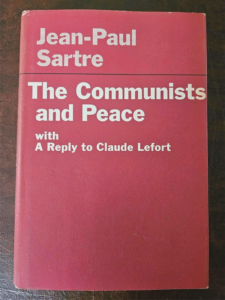
In June 1952, Jean-Paul Sartre was holidaying in Italy when he heard of the arrest of the French Communist Party’s (PCF) acting secretary-general, Jacques Duclos, in what has since become known as the “Carrier Pigeon Affair.” This brought to a head the antagonisms that erupted during the demonstrations organized by the Party against the visit of American General Matthew Ridgeway on May 28, who had recently assumed the command of NATO forces in Europe, and was controversially accused by the Communists of the use of biological weapons in the Korean War. That demonstration spurred a violent confrontation between protesters and the State, to which Antoin Pinay’s government responded with the arrest of Duclos the same evening; and on June 4, the PCF called a strike in defense of Duclos, to which the masses replied with indifference. To the Interior Minister Charles Brune, the presence of what appeared to be carrier pigeons in Duclos’ trunk was sufficient evidence of his coordination with spymasters in the Kremlin; it later came to the fore that these pigeons were dead, and destined for Duclos’ stew pot. “These sordid childish tricks turned my stomach.” Sartre later reflected, swearing “to the bourgeoisie a hatred that would only die with me. When I precipitously returned to Paris, I had to write or suffocate.”1Sartre, ‘Merleau-Ponty, vivant’, in Stewart (ed), The Debate Between Sartre and Merleau-Ponty, p.601 Thus emerged the series of articles entitled “The Communists and Peace,” published serially in Les Temps Modernes between 1952-1954, a frequently trenchant tour-de-force on the problem of political organization and proletarian unity pitched in defense of the beleaguered PCF.
The Communists and Peace is a strange text: an impromptu livre de circonstance,2Literally ‘a book of circumstance,’ more loosely ‘a book of the moment’ – a book that is a direct intervention into a hot contemporary debate or a response to recent events. –Eds. it nevertheless condensed a complex array of theoretical problems that Sartre and his contemporaries had debated for decades. The landmark of this debate was Sartre’s 1943 book Being and Nothingness, a monumental existentialist work that mapped out the conceptual terrain of much subsequent French philosophy. Sartre’s categories of “bad faith,” “authenticity,” “nothingness,” and so on were his attempt to sketch the outlines of a morality after the death of God – a way of living in the world, that is, after one has lost one’s belief not only in traditional religion but all schemes of objective and universal order and meaning. While Being and Nothingness was not explicitly part of a political project, Sartre, like Kant and many other predecessors, proposed that only a theory of the structure of human cognition and experience – how it is that we are able to know or experience anything – could make it possible to form a theory of morality or political action. Famously, Sartre traced out a dualism between the ‘in-itself’ and ‘for-itself,’ the world of passive things contrasted to the ‘nihilating’ freedom of the human subject. According to this theory, the human mind was always free to rise above the conditions in which one found oneself and ‘negate’ them through spirited action.
Several years later, Sartre’s timely intervention in The Communists and Peace precipitated a series of fierce polemics – most notably from Sartre’s erstwhile friend and Les Temps Modernes co-editor, Maurice Merleau-Ponty. Consecrated by Sartre himself as the occasion of his ‘conversion’ toward communism – and thus also a persistent source of embarrassment for those keen on depoliticizing his philosophy – these polemics also constitute the ‘anterior edge’3To borrow Althusser’s designation of the ‘Theses on Feuerbach’ of Sartre’s own transition from “pure” to political philosophy – to put it in terms of his work, away from the conceptual apparatus of Being and Nothingness (1943), and toward the magisterial, but maddeningly unfinished, Critique of Dialectic Reason (1960). Insofar as Merleau-Ponty was concerned, however, even Sartre’s later text is defined by the unremitting repetition of the failures that characterized that earlier work. His main charge against Sartre is that his account of freedom in Being and Nothingness – the dualism between the ‘in-itself’ and ‘for-itself,’ between subjectivity and world, described above – reproduced an unjustifiable division between consciousness and its object, one that leaves the subject totally free to escape the very structures that shape it. But our freedom, Merleau-Ponty insists, is not so absolute. Sartre’s philosophy licensed a dangerous politics, a disciplinary voluntarism that Merleau-Ponty, in his significant but underrated Adventures of the Dialectic (1955), derided as ‘Ultrabolshevism.’ Against this he posed his own concept of freedom, one that sought to stress the sedimentations of one’s embodied, historical relation to the world. While seemingly abstruse, these debates among the existentialists tracked a familiar cleavage in practical political philosophy between freedom and necessity, structural determination and historical contingency, that are still relevant to us today.
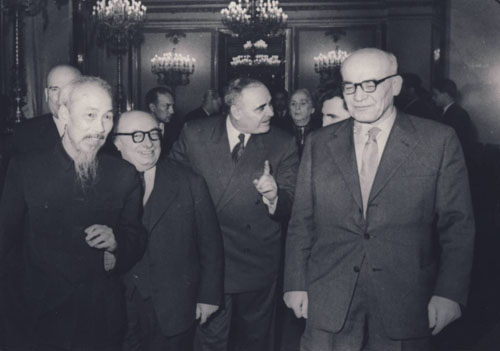
Image courtesy of The National Museum of Romanian History from the Project Communism in Romania Photo Collection.
Like Sartre, Merleau-Ponty’s philosophy blossomed as an existential phenomenology, an interrogation of the nature of capital-B human Being that departs from an examination of the structures of lived experience, “the direct description of our experience such as it is.”4Merleau-Ponty, ‘Preface’ in Phenomenology of Perception, Routledge (2012 [1945]), §7 Centuries before, Rene Descartes had insisted upon the hard distinction between (knowing) subject and (known) object as the basis of his philosophy of mind. Merleau-Ponty’s most notable work, The Phenomenology of Perception, attacks this dogma. For Merleau-Ponty, human beings are an amalgam of mind and matter – and this simple principle yielded an account of the intellect not as something apart from or withdrawn from the world, but as always-already immersed in a meaningful whole, of which the body is an inextricable element. Hence, the familiar procedures of analytical consciousness – sensing, categorizing, synthesizing – occur only against the background of a pre-reflexive perceptual field or context; and Merleau-Ponty mined the nascent science of Gestalt psychology and optical illusions for numerous cases-in-point.
While for the most part a phenomenologist, then, Merleau-Ponty did indeed produce two works of political philosophy – albeit often in the critical rather than constructive mode, and of which Adventures of the Dialectic is the culmination. As we shall see, it constituted a certain aboutface from his earlier Humanism and Terror (1947), itself a (somewhat ambivalent) defense of the USSR amidst the controversy of the Moscow show trials. Like The Communists and Peace, to which it was written as a response, Adventures was a work written in a very particular conjuncture: just one year before Khrushchev’s Secret Speech would reveal the crimes of Stalin, when all but a few of the Communist Parties in the world obeyed Moscow’s directives, and an independent Left tried to assert itself against both these forces and those of an increasingly militarized Cold War liberalism. Merleau-Ponty traces the roots of the authoritarian deviation in the socialist movement to certain problems of dialectical materialism, which he saw as shared not only by the Stalinist orthodoxy but by existentialist variants like Sartre’s, converging insofar as they equally valorized the will of the Party against the indeterminacy of history. Whatever the accuracy of such accusations, the distinctive fusion of conjunctural and theoretical elements that distinguish The Communists and Peace, and the various debates it spawned, offers a rather interesting entry point to an immensely productive period of politico-philosophical activity, one conducted in the shadow of the the ambivalent hegemony of the PCF, amidst the rapid polarization of the incipient Cold War. Despite the evident historical dissimilarities, it remains the case that many of the problems these authors were confronting – the relation between party and class, institution and revolution, and the contingency and violence of political action – persist unresolved to this day.
I
The immediate remit of The Communists and Peace was rather narrow: an attempt to reject the emergent narrative, propagated with relish by both bourgeois and leftist anti-Communists alike, that the events of the May 28th Carrier Pigeon Affair, and the failure of the industrial action convoked in response, all amounted to the decisive repudiation of the Party by the working class they were supposed to represent. For Sartre, on the contrary, “nothing was manifested and there wasn’t any working class,”5Sartre, The Communists and Peace. With a Reply to Claude Lefort, Georges Brazilier (1968), p.67 precisely because this unified entity called the working class could exist only in its articulation through the Party. He writes:
the respectable newspapers tried to show us the proletariat rising in protest against its leaders and we had, on the contrary, the feeling of witnessing its internal collapse […] the strike failed to take place, not because it was condemned by a unanimous outburst but because it aroused millions of aversions that sought to remain individual.6Sartre, The Communists and Peace. With a Reply to Claude Lefort, Georges Brazilier (1968), p.83-84
June 4th thus marked the recession of the proletariat away from their “collective ties” and back into an inert state characterized by a “passive cohesion,” merely “held together by their continuities.”7Sartre, The Communists and Peace. With a Reply to Claude Lefort, Georges Brazilier (1968), p.95 Sartre here refuses the mechanistic notion that sees class unity as emerging from the mere commonality of conditions in production, commonalities which – given the dynamics of competition between workers – are more likely to divide and adjust them to their own exploitation. Such commonalities of course distinguish the proletariat from an ‘arbitrary grouping’: they delimit an objective terrain on which to operate, give rise to certain probabilities and motivations, and render the workers receptive to certain modes of address or intervention. But they are, unto themselves, indeterminate and insufficient. Without what he calls the ‘pure action’ of the Party, which unifies the inert mass of the proletariat by setting it into motion as a fighting-force, it decomposes. As a retort to those jejune leftists lamenting the bureaucratic influence of the PCF over the class, Sartre is uncompromising. “If the working class wants to detach itself from the Party, it has only one means at its disposal: to crumble into dust.”8Sartre, The Communists and Peace. With a Reply to Claude Lefort, Georges Brazilier (1968), 87
This was an unpopular argument, to say the least. Due to their significant role in the Resistance, after the Liberation of France the Communists were recruited into the government as junior partners. This integrationist policy during the reconstruction saw them ratify a wage-squeeze that put them increasingly at odds with the more militant sections of the proletariat, a triangulation they could no longer hold as a strike wave crested in spring 1947.9Linden, ‘Socialisme ou Barbarie: A French Revolutionary Group (1949-65)’, p.10 Expelled from the Ramadier coalition for their intransigence, the PCF became increasingly polarized towards Stalin following the Marshall Plan and the commencement of coordinated anti-communist propaganda efforts. This of course only tightened a relationship that was put in place during the interwar period, where Moscow – keen to incorporate the largest Communist Party in Western Europe – reshaped it in its image, selecting appropriate leaders and eliminating troublesome tendencies, establishing “an authoritarian, rigid, centralized structure that precluded any real internal debate.”10Lazar, ‘The French Communist Party’ in The Cambridge History of Communism: Vol II, p.633 Left-libertarian currents were thus largely accurate in their characterizations of the party as a thoroughly bureaucratized apparatus, one more set on toeing the Comintern line than fomenting domestic revolution; and such a characterization was repeatedly confirmed by a series of apologia and equivocation, not least of which was the Party’s attempted sanitization of Soviet concentration camps in the late 1940s as ‘labor re-education camps,’ a defense that failed in both real courts and those of public opinion.11Christofferson, French Intellectuals Against the Left: The Antitotalitarian Moment of the 1970s, Berghan Books (2004), p.34 It is for all these reasons that Ian Birchall, in his excellent study Sartre Against Stalinism, rejects the suggestion that his rapprochement with the party was driven by intellectual fashion. On the contrary, he “was very much swimming against the stream.”12Birchall, Sartre Against Stalinism, Berghan Books (2004), p.137
To add to all this, it was also a somewhat unusual argument for Sartre himself to make. Up to that point he was by all accounts less politically inclined than, for instance, Merleau-Ponty, who was the de facto political editor of Les Temps Modernes until 1950. Sartre’s position in these years, like that of the journal itself, was always generally ‘non-aligned,’ refusing the Scylla and Charybdis of the superstates while advancing a revolutionary socialism consonant with humanist ideals. In 1948 he was instrumental in the establishment of the Revolutionaire Democratique Reassemblement (RDR), which sought precisely to give partisan expression to this ‘authentic socialism,’ to establish an “intervening force between the USSR and USA.”13Stewart, ‘Introduction’ in The Debate Between Sartre and Merleau-Ponty, Northwestern University Press (1998), p. xxii (The RDR didn’t last long: spurned by the PCF leadership, who prohibited members from participating, it succumbed more or less a year later to internal differences magnified by the pressures of Cold War polarization.) In his editorial capacity at Les Temps Modernes, he signed off on a number of critical pieces directed toward the USSR: a January 1950 editorial, for instance, conceded the charge of ex-RDR member, David Rousset, that the existence of concentration camps warranted a re-evaluation of the state’s ‘socialist characterization’ – although this was tempered by the suggestion that the Soviet project remained a historically progressive force that (somewhat naively) represented the communist ‘idea,’ at least in aspiration.14Birchall, Sartre Against Stalinism, Berghan Books (2004), p.110-111
For all the reasons militating against Sartre’s intervention – not least of which was his own past (although as we know from Being and Nothingness, “freedom is the human being putting his past out of play”15Sartre, Being and Nothingness, Routledge (2003 [1943]), p.52) – it is thus quite curious that he felt the need to make it. That Sartre availed himself of the theological register in describing his motivation (“conversion”) is perhaps significant: he makes clear the strident ethical shift that took place, the “slowly accumulated disgust” at bourgeois society given way, “in an instant,” to the unveiled “horrors of his own class,”16Sartre, ‘Merleau-Ponty vivant’, p.601 so adept at contravening the principles (“liberty, equality, fraternity”) it had promoted; and we might note that this revolt at the hypocrisy of European humanism will prove one of the enduring thematics of Sartre’s political interventions, appearing famously in his 1961 preface to Frantz Fanon’s Wretched of the Earth. In any case, he was not alone in his rallying to the PCF following Duclos’ arrest – other prominent intellectuals, including Paul Ricoeur, felt this tremendous overstep on the part of the capitalist state sufficient reason to bracket their critiques of the Communists17Birchall, 136 – but none did so with such vigor as Sartre. It should be said that, despite all their Stalinist politicking and paternalist inclinations, the Party remained the decisive force on the French left, generally commanding around a quarter of the electorate and presiding over a dense ‘counter-society’ of militants and affiliate organizations, reminiscent of the tremendous institutional latticework achieved by the SPD in the decades prior to the German Revolution. While its hegemonic status was not, unto itself, sufficient reason to defend it, Sartre was right that no other force was adequate to unify the proletariat against its own tendencies to fragmentation and passivity; the mistake, of course, was to assume that this meant the PCF was.
II
The text’s significance is most visible when contrasted with the first salvo launched against it, Claude Lefort’s essay “Le Marxisme et Sartre,” published in the April 1953 issue of Les Temps Modernes. A former student of Merleau-Ponty, Lefort had split from the Trotskyist Parti Communiste Internationale (PCI) in 1948 to found, along with Cornelius Castoriadis, the council-communist group Socialisme ou Barbarie (SouB). Rejecting Trotsky’s conception of the USSR as a ‘degenerated workers state’ – one that mystified its crimes as mere accidents of the superstructures, divorced from the socialist transformations instituted in the base – they advanced a critique of Soviet society as an integrated system of exploitation, thus synthesizing the emergent knowledge of Stalinist repression with an innovative account of bureaucratic class relations.
The natural corollary to this was an opposition to a conventional Leninist model of the Party, which for SouB invariably tended toward the consolidation of a ruling bureaucracy. The so-called importation thesis, in which revolutionary consciousness could not emerge from the working-class themselves — condemned to reach only a reformist ‘trade-union consciousness’ — but had to be imposed on the class ‘from without,’ configured the latter as passive recipients and obedient executors. For Lefort, the PCF constituted a prime example of the “institutionalization of the modes of resistance” that afflicted the parties and unions of the European left, rooting their reformism not only in a set of economic tendencies which encouraged the growth of a labor aristocracy, but crucially “the class’s own movement to […] entrust quasi-permanent representative functions to a minority.”18 Lefort, ‘Le Marxisme et Sartre’, in Éléments d’une Critique de La Bureaucratie, Librairie Droz (1971), (authors translation) Its organizational hierarchization between ‘directors’ and ‘executants’ – an enduring concern of the SouB group – thus mirrored the forms of class-power it nominally sought to contest and tended to neutralize the autonomous capacities of the workers; a dynamic of recuperation19 Recuperation is a left-wing term popularized by the Situationists, meaning the tendency of all critics of capitalism to ultimately be co-opted by it and turned around to serve its ends. In the case of an intellectual or institution, this happens through a sort of carrot-and-stick act, where the powers that be offer former dissidents paths for career advancement or legalization of their political activities so long as they stay within certain permitted bounds, and only those who stubbornly refuse are quietly sidelined, blacklisted, or eliminated. (For a great summary of this dynamic, see Johnny Tran, “The Double Counterinsurgency” in the online section of the magazine.) In the case of an idea, it involves a process of cultural digestion, whereby the anticapitalist or anti-state values of a previous generation of struggle are in the next generation superficially integrated into marketing campaigns, schooling, and other propaganda that serve to direct the attention and energies of potential rebels into the system’s favored channels and away from genuine revolt. As one particularly honest and clear-eyed capitalist puts it in that great work of twenty-first century literature, Disco Elysium (2019): “That’s how simple it is. One may dye their hair green and wear their grandma’s coat all they want. Capital has the ability to subsume all critiques into itself. Even those who would critique capital end up reinforcing it instead.” A great deal of what the financial independence and plain talk of a magazine like ours exists to do is to prove these self-serving musings of Ms. Joyce Messier wrong. Of course, any claim to stand outside recuperation is itself vulnerable to recuperation – a risk we accept knowingly, rather than pretending it does not exist. –Eds. that was exemplified by the CGT’s attempt to contain the August 1953 postal and telecommunications strike, whose emergent demand for direct-democratic production councils risked sidelining the Communist union.20 See Hastings-King, Looking for the Proletariat: Socialisme ou Barbarie and the Problem of Worker Writing, Haymarket (2014), Ch.2 Lefort was a central figure in the non-party left, paradigmatic of the so-called autogestion (self-management) current that was then gaining steam in France, which argued that direct worker control of production in the workplace was the primary mechanism of any transition to socialism. This anti-capitalist, anti-state, anti-party school of thought constituted an effective foil for Sartre. It is perhaps for this reason that, of all of his strident critics in this moment, Lefort was the only one to receive a direct reply.
Their dispute played out as a collision between two rival models of Marxist politics. There have long been different and contending theories of revolution within Marxism: structuralist accounts, which emphasize the maturation of objective economic and social conditions as the precondition for revolutionary rupture; spontaneist accounts, which locate revolutionary agency primarily in the collective self-activity of the working class as it responds to its own conditions of existence; and voluntarist accounts, which assign a decisive role to conscious political organization, party leadership, and acts of decision in transforming diffuse struggle into revolutionary action.21 These positions were articulated in different ways in turn-of-the-last-century Marxist debates – most famously, though with many caveats, by Karl Kautsky, Rosa Luxemburg, and Vladimir Lenin, respectively. –Eds. This debate saw Lefort in the role of the spontaneist and Sartre, ever the partisan of choice and decision, in that of the voluntarist, each nominally distinguished by their respective proximities to the objective and subjective dimensions of the class-struggle.
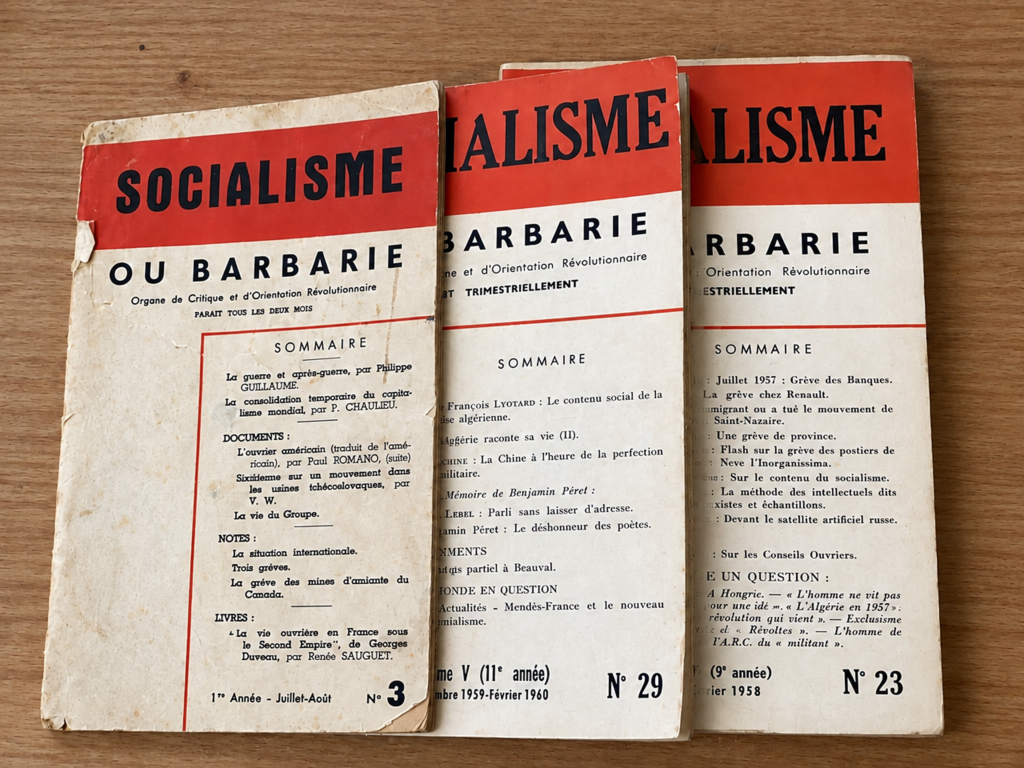
Lefort’s notion of ‘proletarian experience’ – advanced initially in a titular article for Socialisme ou Barbarie, and rehearsed for the audience of Les Temps Modernes – stressed the sufficiency of the practices and knowledges accumulated by the class on their own terms, without the external intervention of the Party. The result is a conception of revolution that develops more or less organically from their immersion at the point of production. Thus he posits a simple continuum of immediate and fundamental interests – in which the struggle for wages and conditions, skirmishes at the level of capital’s reproduction, ensure “progress in the organization of the movement” – and stresses the comporting effects of industrial production, unifying workers in the great spatial concentrations of Fordism.
This closely tracks certain elements of Marx’s thought. For him, famously, the factory provides the cohesion and discipline that is the material root of class consciousness. But Lefort takes this further: the proletariat’s proximity to the constantly revolutionizing techniques of modern industry imbues it with a remarkable flexibility. Workers, Lefort writes, are able to “create new bodily arrangements in response to the demands of the environment” – a testament to the immense creative capacities that Marx himself considered the “greatest productive force.” Yet under present conditions, Lefort argues, this capacity is smothered by the Party.
Against the Party, Lefort centers the concept of cumulative proletarian experience. Workers find themselves in conditions not of their choosing; they react to these conditions and struggle against them; in struggling they realize there’s a struggle at all, which they are the protagonists of; and the struggle leaves the material conditions and the workers alike changed. This generates a history, an accumulation of self-knowledge and practices tested by experience. As the proletariat matures and unfettered capitalism gives way to Fordism, Lefort writes, the working class absorbs these material processes into its own consciousness. This is a journey with a fixed direction: for Lefort, this entire process is nothing less than the quasi-teleological unfolding of an “ever increasing capacity to direct” – the working class’s evolution towards its sovereignty over the productive process. History is teaching them how to become the rulers of their work, their own self-managers. If this is true, it radically delimits the space of legitimate organization – now reduced to the method of workers’ inquiry, the sociological study of particular workplaces and their conditions, which Lefort sees as an attempt to generate an active consciousness of autogestion through questionnaires and proletarian writing that foregrounds the masses’ collective ingenuity. By contrast, Sartre is charged with effectively uprooting “the class from its social and historical existence,” rendering the workers as unconscious disjecta membra (scattered fragments) to be soldered together by the sheer will of the Party.22 Lefort, ‘Le Marxisme et Sartre’, in Éléments d’une Critique de La Bureaucratie, Librairie Droz (1971), (authors translation)
Sartre, in his “Reply to Claude Lefort,” published in the same April 1953 issue of Les Temps Modernes, emphatically rejects Lefort’s assertion that he disavows the pertinence of the objective factor: “Never have I denied the deep roots of the worker in society,”23 Sartre, ‘Reply to Claude Lefort’, in The Communists and Peace, p.233 he begins, thus taking the opportunity to defend the distinction between the class as ‘mass’ and ‘collectivity’ that he formulated in The Communists and Peace. If the former means seeing the working class as merely a sociological regularity, tendentially formed by a set of external causalities, the latter considers the class as the product of its own conscious political will to unification. This concept of ‘the mass’ crucially anticipates the category of the serial group developed in the Critique of Dialectical Reason (1960), famously exemplified by the case of the bus queue as a ‘plurality of isolations’:24 See Sartre, Critique of Dialectical Reason, Verso (2004 [1960]), Book 4, Part iv, Ch.1: ‘Series: The Queue’ nothing more than a multitude of individuals, the concordance of whom derives not from the express coordination of their wills but from equal subjection to situational demands. People forming a mere ‘mass’ of this kind are negatively structured by their common object and the shared but conflictual imperatives to which their passive involvement in that activity gives rise (to get home on time, to shunt past the Other in a rush, and so on). By contrast, only a formally self-organized group of politically organized workers can form a true ‘collectivity’ willing and able to contest power in society.
In the structure of The Communists and Peace, Sartre argues, such a distinction does not deny the pertinence of objective circumstances to the formation of the class. He devotes considerable attention, for instance, to the relation between specific technical compositions of labor and their emergent political articulations – that is, to the way a productive process is structured on a technical level, and how this affects the forms of political consciousness likely to emerge among the workers within it. He knows, moreover, that “exploitation beyond a certain threshold counteracts the massifying forces,” is likely to “provoke a rapid crystallization of the working masses” – for “needs can engender a will to union.”25 Sartre, The Communists and Peace. With a Reply to Claude Lefort, Georges Brazilier (1968), 81
Nevertheless, the question that remains is whether or not such tendencies are sufficient, or whether they require an agent capable of transforming their “involuntary tide into a precise operation”26 Ibid., 207 – namely, the operation of bringing about not just a quantitative but qualitative shift in the logics of class composition, a change that cannot simply be read off from the objective conditions of production. It is this that Sartre intends when he argues that the worker can become proletarian only “to the extent that he refuses his status,” converting their default massified state – subject to the fragmenting imperatives of the boss and labor-market – into an active political unity.
To this end, he is withering as regards Lefort’s spontaneism, which for him only conceals a mechanical account of class formation in which the “subjectivity of the working class is one with the mode of production.”27 Sartre, ‘Reply to Claude Lefort’ in The Communists and Peace, p.246 It is hard to deny the accuracy of this critique: Lefort’s fundamental contention that the unification of the proletariat continues “in parallel with the concentration of capitalism” reproduces Marx’s undue optimism near the end of Capital Vol.1, where the process of class-formation is presented as already done for us, the masses “trained, united, and organized by the very mechanism of the capitalist process of production.”28 Marx, Capital: A Critique of Political Economy – Volume I, Penguin (1976 [1867]), p.799 It is this faith that licenses his attempts to extract the ‘solidarity of cooperation’ from the compactness of industrial production – “like a rabbit from a hat” – obscuring how capital configures the labor-process precisely as a means to disrupt this solidarity, proliferating internal differentiations in foremen and piece-rate systems, and, we might add, incorporating and intensifying pre-existing logics of exclusion in race and gender. The “interchangeability” of tasks in the assembly line moreover marks not a “sensitivity” to “universality,” but the “fear of losing one’s job, the agonizing feeling that one is replaceable”;29 Sartre, ‘Reply to Claude Lefort’ in The Communists and Peace, Ibid., p.252 and without institutions powerful enough to change the calculus of the situation, such fears drive workers to accommodation more regularly than resistance. In Lefort’s anxiety to foreclose any gap in which the party could intervene he elides the tremendous political effort required to articulate a class-unity across identitarian, sectoral, and technical particularisms; what Mike Davis, citing the efforts to establish a United Automobile Workers chapter in 1930s Detroit, described as the “intricate diplomacy” necessary to “unite a dozen ethnically segmented plant departments, each with its own distinctive ‘social personality’ and set of grievances.”30 Davis, Old Gods, New Enigmas, Verso (2018), p.49
It is to Sartre’s credit that The Communists and Peace insists so vociferously on the composition of the class as the problem rather than as the premise of the struggle, one that requires specific institutions dedicated to formation beyond sectoral interests or emergent defensive modes. In this capacity he emerges from the scuffle with Lefort as seeming strangely contemporaneous to us, although perhaps not for the reasons he would have liked. The pressures to seriality that he was able to theorize have only been exacerbated by the dispersal of de-industrialization and the precarity of service work, further scattering the common-world out of which revolution might be forged; and the historical defeat of the workers movement, layered by the anti-social interpolations of communicative capital, have acted as force-multipliers for these centrifugal dynamics. His stress on the party was not an attempt to deny the effectivities of this condition – its specific motives and sociological tendencies – but only to emphasize that, as he put it somewhat gnomically, “the synthetic unity of effects cannot prove the synthetic unity of an enterprise.”31 Sartre, ‘Reply to Claude Lefort’ in The Communists and Peace, p.262 “There must be someone,” he concludes, “to transform into upward thrust the weight which drags the masses down, to transform suffering into demands.”32 Ibid., 278
If his riposte to Lefort on the theoretical level was effective, his defense of the specific form of such organizational initiative (the Leninist party-state) was, as we shall see, much less so – a problem further illuminated by his confrontation with Merleau-Ponty.
III
If the early 1950s saw Sartre gathering closer to the communists, his trajectory was mirrored in the inverse by Merleau-Ponty. In June 1950, the North Korean People’s Army, trained and supplied by the Soviets, invaded their Southern neighbors; UN forces, led by the United States, rapidly mobilized to repel them. So began the first proxy war of the era, one that put an abrupt end to the ‘wait-and-see attitude’ that Merleau-Ponty had until then entertained toward the USSR and Marxism, an attitude in part motivated by his trust that the Soviets – whatever else they were doing – were nevertheless not angling toward a new military conflagration. Prior to Korea, Merleau-Ponty was under no illusions that the Stalinist regime was “very far from the revolutionary criteria defined by Lenin,” but he was nevertheless determined to maintain a principled “sympathy without adherence.”33 Merleau-Ponty, Adventures of the Dialectic, Northwestern University Press (1973), p.229 This was reflected in the strange equivocation of his Humanism and Terror (1947), a philosophical response to Arthur Koestler’s novel, Darkness at Noon (1948). Written by an ex-communist (and financed by the covert arm of the British Foreign Office, ever a shrewd investor in anti-Soviet propaganda), Koestler’s book was a fictionalized treatment of the Moscow show trials conducted at the end of the 1930s, in which many of the old Bolsheviks – now members of the clandestine Trotskyist or Rightist ‘opposition’ to Stalin – were deemed imperialist conspirators and duly executed.
At this stage, Merleau-Ponty sought to contextualize the trials as a determinate phase in Russia’s revolutionary sequence, one in which all hands are bloody and “every action involves us in a game which we cannot entirely control.”34 Merleau-Ponty, Humanism and Terror, Beacon Press (1969), xxxviii The contingency of history makes “political divergences irreducible and cunning, deceit and violence inevitable,” a truth heroically grasped by the generation of 1917.35 Ibid., p.96 He was therefore resolutely opposed to the abstract humanism of the liberals, a hypocritical ethic that concealed how “all regimes are criminal.” That bourgeous society equally depends upon the “death of a Negro lynched in Louisiana, or of a native in Indonesia, Algeria, or Indochina,” ought to dissaude any hawkish denunciations of communist repression. The question is thus not ”whether one accepts or rejects violence, but whether the violence with which one is allied […] tends toward its own suspension or self-perpetuation.”36 Ibid., p.1 And Marxism’s wager is that such violence is posed in order to eliminate it.
As an evaluation of the Soviet Union on these grounds, Merleau-Ponty argues that the irruption of the materialist dialectic in the backward state of Tsarist Russia — that is, the emergence of proletarian agency within a social formation that had not yet made a transition out of feudalism, such that the class had not properly ‘matured’— constricted the revolution, forcing it to adopt a defensive mode in which rapid industrialization came at the expense of freedom of criticism and the militarization of labor. Stalin’s mistake was to rip this tactical function of violence from its ultimate end, namely to foster the independent proletarian consciousness that sets the ground for what he calls a ‘humanism in extension,’ the universal recognition of our capacity for meaningful self-determination.37 Ibid., p.176 Whether or not this was to be the end-point of the revolutionary project was at this stage unclear; but Merleau-Ponty at least had the acuity to note that the liquidation of the previous generations, and the ideological hammering of the new, made the existence of any independent source of renewal increasingly unlikely.
Nevertheless, despite his pointed criticisms of the regime’s reactionary and revisionist nature, Merleau-Ponty presents a tragic picture of the show trials. They were in some sense, for him, fated by history. No matter the individual desire of those in charge of the regime, they had to be conducted; no matter the intentions or indeed innocence of the accused, their acts could only ever have been deemed counter-revolutionary. This resolves the paradox revealed by the trial of Nikolai Bukharin in particular, who assumes responsibility for acts of treason but refuses the name of traitor: the trials represent not a “judgement on the person but the appraisal of an historical role,” and whether Bukharin himself opposed the task of building socialism or not, his actions would be used by those who did.38 Ibid., p.60
One is left with the impression that Stalin’s hand was forced by the complexity of historical circumstance, that the encirclement of the communist bloc ‘objectively’ renders criticism nothing more than an appendage to reaction. But here the fates tend to substitute for history. And in this work at least, Merleau-Ponty refuses to investigate whether such realpolitik is in fact no consequence of any natural trajectory – the revolution ossifying under the weight of its own mission – but rather a predictable outcome of the specific regime Stalin instituted, one that blocked its capacity for course-correction and turned sedition into the only effective route to transformation. For his part, Merleau-Pony rejected the accusation that he proffered an apologia for Stalin, instead characterizing his text as but a “slightly frank view of history.” To object to this for its equivocation misses that this is indeed the book’s central point: “the contingency of the future, which accounts for the violent acts of those in power, by the same token deprives these acts of all legitimacy, or equally legitimates the violence of their opponents.”39 Ibid., xxxvi
If in 1947, the case of Bukharin – that one cannot disavow the “objective pattern of his actions”40 Ibid., p.64 – at this stage legitimated Merleau-Ponty’s suspension of judgement on the regime, by 1950 it prompted the opposite. A neutral position on the Soviet Union was, he came to believe, untenable. In particular, a stance of sympathy without adherence was becoming increasingly quixotic as the lines of force between the superpowers sharpened. In the end it was Russia’s perceived belligerence in Korea that finally dispelled Merleau-Ponty’s hope that the regime was ultimately – or at least in aspiration, and despite the calcification that had taken hold – a progressive force. This event was to precipitate, at first, a thoroughing silence from Merleau-Ponty on political matters – a silence he sought to impose on Les Temps Modernes as a whole with his resignation as political editor, which left the journal largely rudderless until Sartre’s conversion in 1952. Remaining on as co-editor, however, Merleau-Ponty saw fit shortly thereafter to issue an exculpatory preface to a piece by an external contributor on ‘The United States and the Contradictions of Capitalism,’ whose failure, as Merleau-Ponty saw it, lay in its omission of the equally severe contradictions of socialism.41 Bichall, Sartre Against Stalinism, p.123 Sartre, “insulted by the effrontery and heavy-handedness of the preface,”42 Stewart, ‘Introduction’, in The Debate Between Sartre and Merleau-Ponty, xxv unilaterally removed it. This resulted in the final departure of Merleau-Ponty from Les Temps Modernes, and an end to the enduring friendship between these two giants of postwar philosophy.
IV
These personal fractures could not but show themselves in their work. Thus in 1955 Merleau-Ponty published his most substantive text of political philosophy, Adventures of the Dialectic, whose famous polemic against Sartre’s ‘Ultrabolshevism’ occupies almost half of its otherwise relatively slim 235 pages.
Taking a rather similar tack to that of his ex-student, Claude Lefort, Merleau-Ponty accuses Sartre of substituting the dialectic with an ‘extreme subjectivism’; the “nonbeing of the proletariat and the decision which, out of nothing, creates the proletariat as the subject of history.”43 Merleau-Ponty, Adventures of the Dialectic, 98 Central to Merleau-Ponty’s critique is what he takes to be the absence of an ‘interworld’ in Sartre’s ontology, a residual failure stemming from Being and Nothingness’ (1943) inability to extend beyond the terrain of the cogito.44 As in, the famous statement by which René Descartes inaugurated the birth of modern philosophy: cogito ergo sum – “I think, and therefore I am.” What Merleau-Ponty is ultimately accusing Sartre of is methodological individualism. To begin philosophically with the subjective consciousness of the individual, the argument goes, to ignore the way that individual is shaped by larger social forces – and thus leads to the political error of emphasizing the conscious will of a minority, like the party, over the spontaneous self-organization of the class. –Eds. As proof of this accusation, Merleau-Ponty cites Sartre’s remark that there are only ‘man and things’ – an opposition which, in the structure of Sartre’s classic work, is seen to reduce the latter as an inert background against which the former’s absolute freedom asserts itself, a naked objectivity of which it is the essence of consciousness to appropriate or suspend. Merleau-Ponty contrasts this to the “mixed milieu, neither things nor persons, where intentions are absorbed and transformed,” decayed, diverted, or reborn in another guise – which he regards as a correct description of the relation between individual consciousness and society.45 Merleau-Ponty, Adventures of the Dialectic, p.125 Sartre thus putatively denies the ‘probabilities’ of social objectivity,46 Ibid., p.184 the material tendencies that proceed behind our backs, and which of course concentrate in the structural location of the proletariat.
His attempt to refuse the mechanical emergence of class unity from the the brute “identity of interests and conditions” that we tracked in section II is here construed as an argument to the effect that it does not “arise from it all”; and, extending his analogy from Being and Nothingness to the later political writings, Merleau-Ponty maps Sartre’s caution as to the political indeterminacy of such tendencies onto his earlier argument as to the insufficiency of empirical ‘motives’ to prompt acts of consciousness.47 Ibid., 106 To put it bluntly, not only is an experience of exploitation insufficient to make one a communist, but Merleau-Ponty implies that for Sartre, that experience is not pertinent at all. Instead freedom intervenes as a radical negating48 By negating, Sartre is taken to mean not simply the ability to deny something, but a capacity to suspend what happens to be the case and transform, transcend, or surpass it. It is in this sense that, famously, “the red hot pincers of the torturer do not exempt us from being free”: a refusal to rat on one’s comrades emerges as a negation of the pain coursing through the body, and a concomitant determination of that pain not as a something capable of inducing capitulation, but as something it is possible to transcend by virtue of a commitment to a project in light of which the immediate situation is structured. See Sartre, Being and Nothingness, p.527 force, singularly able to extricate itself from the causal chain determinative of being; and from this Merleau-Ponty adduces a structure of temporality – or, more precisely, its lack – in which “political time is atomized … into a series of decisions taken in the presence of death.”49 Merleau-Ponty, Adventures of the Dialectic, p.117 Since Sartre’s concept of freedom is putatively divorced from the sedimentations of one’s context and antecedents – and in fact proceeds by negating such sedimentations – “it allows only for sudden interventions into the world, for camera shots and flash bulbs.”50 Ibid., p.193 Having excluded the organic emergence of revolution out of the material tendencies of capitalism, therefore, the decisiveness of the Party’s action becomes the only possible mechanism for generating proletarian liberation, the thin line which separates the class from unity and disarray. The absolute necessity of this task, and the vertiginous risk posed by its failure, is thus taken to ratify a particularly disciplinary model, one whose rigidity is “only the counterpart of the equivocalness of facts.”51 Ibid., p.117
With this critique we find ourselves on quite familiar ground. We have already seen, with the case of Lefort, various occasions in which Sartre’s purported subjectivism is more nuanced than it is made out to be. If Sartre himself didn’t feel the need to clarify such misunderstandings – Adventures received no direct reply – the task was nevertheless taken up by Simone de Beauvoir in her “Merleau-Ponty and Pseduo-Sartreanism,” published in the July 1955 edition of Les Temps Modernes. An exquisite counter-polemic, her parodying of the title of Merleau-Ponty’s essay sets the tone. Methodically counterposing his strawman of Sartre to the actuality of his work, she reproaches Merleau-Ponty for decontextualizing chance statements and twisting the meaning of others, often to quite amusing results. Concerning Sartre’s ontology of the proletarian condition, Merleau-Ponty declares that “it is not a historical reality”; and Beauvoir is quick to point out that Sartre writes, in black and white, “The French proletariat is a historical reality.”52 Beauvoir, ‘Merleau-Ponty and Pseudo-Sartreanism’ [1955] in Stewart (ed), The Debate Between Sartre and Merleau-Ponty, 468 Alongside these occasional howlers, she persuasively elucidates Merleau-Ponty’s elision of the category of situation in Sartre, the realities “which resist consciousness and possess their own laws.”53 Ibid., 456 The assertion that Sartre ignores material ‘probabilities,’ for instance, is flatly contradicted by his contention that “the historical whole determines our powers at any given moment, it prescribes their limits in our field of action and our real future,”54 Sartre, The Communists and Peace, 80 a field of which it is the job of the militant to make ‘conjectures’ on. And we might note further that the entire thrust of his “Reply to Claude Lefort” consists not in stressing the ambivalence of the social but the real weight of its facticity, the drag placed on agents by the mute compulsion55 ‘Mute compulsion’ as in the structural determination of some political outcome – the fact it had to have happened due to the arrangement of the larger social forces, usually those of capitalism, rather than its having been contingent upon the balance of forces between different conscious political actors, which could have made it go another way had that balance been different. This is an old debate between Marxists. At bottom it is a disagreement about the precise relationship between individual or group agency and social structure. Is it that “man does make history, only not under conditions of his choosing”; or is it that “the capitalist is merely capital personified and functions in the process of production solely as the agent of capital,” with the workers presumably being the same vis-a-vis the interests of labor? These are not quite the same thesis, except if you squint. The people who like Das Kapital and value-form theory tend to go in for structural determinism; the ones who like the Eighteenth Brumaire or Gramsci, for the contingency of social struggles depending on the balance of forces. It is a debate all the more intractable since the old man provided us with quotes in support of both positions. Recently, ‘mute compulsion’ has become a popular shorthand for the structural-determinist position, a possible translation of a phrase from Das Kapital Volume I that the Danish Marxist philosopher Søren Mau made the title of a popular Verso book in 2023. –Eds. of their situation, which precisely militates against the sporadic conversion of objective conditions into proto-revolutionary unity. To say that “the possibilities are all equally distant”56 Merleau-Ponty, Adventures of the Dialectic, 132 has more in common with Lefort’s truncated dialectic, in which the workers oscillate between their degradation and valorization as appendage of the machine, than Sartre’s account of seriality.
If Beauvoir is correct that Merleau-Ponty’s objections are generally misplaced – perhaps displaying an anxiousness to distance his own ontology, which more explicitly departs from consciousness’ embeddedness in a prereflexive reality, from that of his ex-collaborator – they still nevertheless capture something important of The Communists and Peace, namely the paltriness of the notion of the Party advanced therein. Merleau-Ponty is accurate in his estimation that “this heroic enterprise tolerates no sort of condition or restriction.”57 Ibid., 101 The Party’s essence, Sartre himself admits, is to be an “Order which makes order reign and which gives orders”; as such it must be incubated from any ‘seeds of division,’ from the prevarications of internal dissent and deliberation.58 Sartre, The Communists and Peace, 128 What permits this strikingly disciplinary conception is the absence in Sartre of any real sense of the institution’s weight or inertia, of those particular procedures that might precipitate a dynamic of institutional self-preservation over and against the goals it was created to achieve in the first place. Borrowing a concept from his later work, we can understand this as a process of what he then calls ‘counter-finality,’ or forms of objectified action which exceed or even negate their intentions – paradigmatically represented by the problem of bureaucratization. Here we do in fact find a crucial analogue to Being and Nothingness, although one not stressed by Merleau-Ponty, in which the stringent formalism of consciousness – there defined as a propertyless transparency or ‘window’ in which the object of selfhood intermittently arises – is mirrored by the hollowness of the Party’s ‘pure action,’ a simple converter or elaborator for the class.
Such an omission gets to one of the central peculiarities of the text. Despite being a rather direct defense of a specific institution, Sartre lacks a concept of institutionality as such, its internal configuration, mechanisms, and relations of command. To the extent Sartre broaches these matters, we find a meager rendering of what the intellectual historian Albert Hirschman would call ‘exit’ as opposed to ‘voice’ as modalities of influence.59 See Albert Hirschman, Exit, Voice, and Loyalty, Harvard University Press (1970) According to this notion of ‘exit,’ the mass can tip the scales only to the extent they withdraw their support from the apparatus, thus substituting their capacity to democratically re-formulate the collective line with a faith in the leaders to adequately adjust course in response to the ‘ebb and flow’ of membership rolls. Sartre here deploys an unfortunate nautical metaphor – “the masses control the militant as the sea controls the helmsman”60 Sartre, The Communists and Peace, 215 – that has the telling effect of rendering the class a kind of impulsive natural force – precisely what their articulation through the Party is supposed to prevent, nominally raising them to a state of effective self-government. In this respect, one could hardly doubt Socialisme ou Barbarie’s critique of the Party as neutralizing rather than developing proletarian political capacity.
Elsewhere – and as yet another instance of the inaccuracy of Merleau-Ponty’s critique, although this time not to Sartre’s favor – Sartre advances a peculiar objectivism by which a strict division of labor follows as a simple reflection of the specialization of tasks characteristic of Fordist industrial regimes, thus reproducing the reified division between ‘brain’ and ‘hand’ on which the midcentury order was based. Whilst we can concede that institutionality requires some division and specialization, the sanguinity with which Sartre treats these matters is unmistakeable: “since others think for the semiskilled worker,” he reasons, imperturbed by the direction of his own argument, “it is quite necessary that other specialists, in other offices, think in counter-balance.”61 Ibid., 123 As a consequence he permits the class only one option – “they follow or don’t follow, that is all” – and we would be right to ask whether the severity of this choice, to submit or “abandon themselves to the forces of massification,”62 Ibid., 215 does not in a crucial sense foreclose it in advance. Having raised the possibility of bureaucratization, he peremptorily dismisses it, comfortable in his trust that leaders only exercise the powers delegated to them. But as the decade charges on, and events strain his pact with the PCF, he will find such a position increasingly difficult to sustain. And ultimately, he will come to integrate elements of Lefort and Merleau-Ponty’s critiques into the construction of a new theoretical apparatus.
V
Whatever its merits, “Sartre and Ultrabolshevism” was only the culmination of a larger argument, the endpoint of Merleau-Ponty’s titular adventure of the dialectic. On the one hand, this was an attempt to extract from the (then still emerging) tradition of ‘Western Marxism’ an authentic dialectic that might escape the perversions of the official philosophy of the Eastern Bloc. To this end, Merleau-Ponty reads Lukacs’ critique of reification in History and Class Consciousness (1923) – which targets capital’s distortion of social phenomena into an inflexible ‘second nature,’ economic logics churning on independent of human action – as grounding an open-ended conception of the dialectic. Revolution in this view consists in a continual process of negation – which is to say, a continual process of extricating and elevating the class from its bourgeois, reformist, and corporatist tendencies, these obstacles and intermediaries on the path to emancipation – mediated by the Party as organ of exchange between leaders and mass, theory and praxis.
This attempt to “incorporate subjectivity into history without making it an epiphenomenon”63 Merleau-Ponty, Adventures of the Dialectic, 41 – to account for the conscious acts of individual political actors, without reducing their sense of self to an illusion generated by totally determinative structural forces – contrasts with the mechanical materialism which rapidly took hold in Russia. This rigid Stalinist view buried the dialectic in the clockwork procession of inert things, reducing consciousness to a simple correlate of the development of productive forces. And such a crude philosophy was itself a theoretical cover for the authoritarian industrialism of Stalin: the politburo as the true ‘knowing Subject’ of history, manipulating the social process in the model of the technician.
On the other hand, in the course of Merleau-Ponty’s argument, this opposition between what might be understood as a historical and mechanical dialectic gives way to a condemnation of Marxism as such, which proves ultimately unable to escape the vortex of violence through the contingencies of a revolutionary sequence. Here we find the true meaning of Sartre’s purported ‘ultrabolshevism’: it is the working out of a logic internal to the communist project, his early and unsuccessful attempt to save it from itself. That he elides the interworld, rather than accounting for it, only registers in philosophical form the steamrolling of history to which the dialectic was destined in the twentieth century. “If one concentrates all the negativity and the meaning of history into an existing historical formation,” Merleau-Ponty laments in the epilogue, “then one has to give a free hand to those who represent it in power, since all that is other is an enemy.”64 Ibid., 207
It is worthwhile noting that, contrary to Sartre’s treatment of the party in The Communists and Peace, the concept of institution assumes decisive importance in the crucial chapters of Adventures. In the first place, and in a rather maximalist gesture, ‘institution’ is posited as a synonym for history itself. It denotes precisely that ‘mixed milieu’ which blends subject and object, ‘spirit and matter’: an “order of ‘things’” which is nevertheless always “dependent on its meaning,” its own relations of causality consisting of only dormant forms of praxis, and thus liable to be revised or re-appropriated as such, although not without resistance.65 Ibid., 64-65 This shares much with the account developed in Merleau-Ponty’s contemporaneous lecture series, later collated together under the editorship of Claude Lefort as Institution and Passivity: here the subject is inserted in an instituted field that they receive and adopt a certain passivity toward. More than empirical ‘institutions,’ this field marks out the heritage of all existing experiences and structures, the sedimentations of historical being that one comes to adopt in each process of self-making. But the continuity of this field does not preclude the possibility of iteration or transformation, its elements marking out the lineaments of a future that subjects are always in the process of instituting.66 See Merleau-Ponty, Institution and Passivity: Course Notes From the College de France (1954-1955) For Merleau-Ponty, the nature of this general concept of institution – understood as the relational fabric of historical social-being – tends to falsify a conception of revolution as “the end of history,” an epochal new beginning which splits temporality down the middle and consequently elides the “logic in things which tends to make the remnants of capitalism regenerate themselves.”67 Merleau-Ponty, Adventures, 129. Careful readers may note that, beneath all the continental-philosophical jargon, this idea of an institution that prepares its participants for a differently organized future greatly resembles the anarchist idea of prefiguration. See for example Paul Raekstad & Sofa Saio Gradin, Prefigurative Politics: Building Tomorrow Today (2020). Though Merleau-Ponty’s framing highlights a point of emphasis that the anarchist one usually underemphasizes – that institutionalization can work in the opposite direction, closing the doors of emancipatory historical possibilities instead of opening them, if all we have around us are institutions that reconcile us to the way things presently are. –Eds.
This motivates the second conception of institution, now marking the ‘congealing’ or ‘denaturing’ forced by the revolutionary project’s collision with the inertia of the interworld. Under Leninism, the imperatives of institutionalization ensure that the negativity incarnated in the proletariat, its historic tendency to abolish capitalism, cannot but turn into its opposite. The proletariat’s inability to immediately efface the residual forms of bourgeois rule thus precipitates the construction of a proto-State apparatus powerful enough to solidify the revolution, to stabilize it through the inevitable missteps and counter-revolutions. The necessity of martial discipline herein – think of the Jacobin Committee of Public Safety, or the Soviet All-Russian Extraordinary Commission, the notorious Cheka – tendentially converts political into military relations, the leadership accustomed to the deployment of violence as means to steady the ship. In turn, this generalization of repressive measures is ratified by a conception of the Party-hierarchy as embodiment of Truth, its proleptic action permitting the dissociation of its authority from the class, able to “step over all obstacles” on the understanding that “those who will be shot would understand tomorrow that they did not die in vain.”68 Ibid, 123 The combination of these problematics finally bequeathes, for Merleau-Ponty, an apparent justification for a ‘new liberalism,’ one that escapes what he calls the ‘circle of revolution’ and finds comfort in the indeterminacy of history. Making his final farewell to Marxism, he argues that “revolutions are true as movements and false as regimes… precisely because [they] succeed and end up as an institution.”69 Ibid., 207
Merleau-Ponty has therefore travelled quite far from Humanism and Terror, and we ought to understand Adventures of the Dialectic as, amongst other things, an explicit self-critique, adopting in inverted form the conceptual apparatus of what came before. Where once, in the older work, the thematic of contingency had supposedly expressed the essential structures of human action and dramatized a “realist” conception of politics as a “pact with the powers of hell because it is the struggle for power,”70 Merleau-Ponty, Humanism and Terror, xli now it has become the hurdle over which the revolution cannot but stumble. In what he’d thought of as the demystified humanism of his earlier Marxism, the syncopation of violence and truth was a process by which the former is condemned to anticipate the latter, precisely as the only means by which their synthesis – a revolution that expresses the ‘truth’ of history as human emancipation – can be brought about; but now, in the fatalism he has adopted years later, it is a trap from which militants cannot escape.
For radicals, it is all too easy to critique the turn to liberalism that follows. When Merleau-Ponty gestures toward the plasticity of capitalism, touting the possibility of recalibrating its “instruments” or its capacity to let “even what contests it enter its universe,”71 Merleau-Ponty, Adventures, 226 it is hard to disagree with Beauvoir’s barb that “Merleau-Ponty, with surprising naivety, discovers reformism.”72 Beauvoir, ‘Merleau-Ponty and Pseudo-Sartreanism’ [1955], 484 And as for his faith in the capacity of Parliamentarism to “guarantee a minimum of opposition and truth,”73 Merleau-Ponty, Adventures, 226 one is tempted to use his earlier words against him: that “if civilization is defined by a wise balance of power, then the latter civilization is still struggle, violence, and the lack of reciprocity.”74 Merleau-Ponty, Humanism and Terror, 119 But what is perhaps less easy to dismiss is the acuity with which he sets forth the problem of revolutionary institution – ”is revolution an extreme case of government or the end of government?”75 Merleau-Ponty, Adventures, 216 – and the pessimism of his answer.
Nevertheless, we would be right to caution against a certain abstraction in his account, in which the reductio ad absurdum of a philosophical schema substitutes for an argument as to all the possible organizational configurations in a given politico-historical sequence. One can see where he’s coming from, of course. To say that revolution is a “negativity embodied in history” is surely to raise the doubt, as Merleau-Ponty does, that one can conceive of “a continued, established, flow, of a regime that would live at this level of tension … of a life without lasting attainments and without rest.”76 Ibid., 90 But that some ‘positivity’ or ‘particularity’ must eventually cohere from what the revolution has broken apart, is not equivalent to the proposition that this must constitute the simple repetition of class-rule – a fate which Merleau-Ponty projects onto the revolutionary project with a necessity unbecoming of a thinker so attuned to contingency.
This exposes a tension in his concept of institution, too. The tension articulates itself through a semantic field that oscillates between a logic of intentional praxis and quasi-naturalistic idioms: for Merleau-Ponty, institutions are always ‘congealing,’ ‘denaturing,’ and in ‘decadence’ – the betrayal of the revolutionary project proceeds akin to the curdling of milk, and social order as such is made equivalent to its hierarchization. He has conceded everything, in effect, to the reactionaries, for whom there can be no social order but rank, no rule but class rule. Such an argument is supplemented by some dubious assertions to the effect that Marxism lacks internal resources for thinking the risk of the movement’s usurpation by its representatives. This conveniently omits (to name one example of many) Rosa Luxemburg’s prescient critique of Bolshevik centralism in the 1918 pamphlet, The Russian Revolution, and the whole left-libertarian current in which her writing was to find an enduring audience, from the Workers Opposition faction to Anton Pannekoek’s council communism. And to attribute to Marx the view, plain and simple, that the proletariat must “make its own the State apparatus which served to oppress it”77 Ibid., 130 ignores the revelation of the Paris Commune, relayed in “The Civil War in France” (1871), that the class cannot simply lay claim to a ready-made state machinery and wield it to our own purposes – a caution that exemplifies a sensitivity to the problems of properly democratic constitutional design, of the importance of mandated delegation as well as the dissolution of bureaucratic functionaries, and so on.
This is all well and good, Merleau-Ponty might have replied, but good intentions can only get you so far. The problem of revolution places us right up against the limits of human praxis; the world-historical challenge of transforming our mad totality, of intervening into interminable chains of causality before they swallow us whole. More than intention, such a task must grapple with the unforeseen and unintended, what Merleau-Ponty calls the domain of “dulled actions” – “bastard notions in which actual conditions, negligences, abstentions, and decisions are mixed”78 Ibid., 145 – and in which we find the final reversal from Humanism and Terror. The deterioration of Bolshevism from its heroic moment, epitomized by the radical democratic demand for “All power to the Soviets!”, to the horrors of Stalinism is thus a prime instance of such inversions and muddles, testament to the difficulty of willing total social transformation. And if in that earlier text this openness of human praxis called forth a leap into the abyss – the epochal moments which demand “fundamental decisions… where the risk is total because” it depends “upon a conjuncture not entirely foreseeable”79 Merleau-Ponty, Humanism and Terror, xvii – it now merits a firm retreat away from the edge. Politics becomes a terrain of compromise, of dimmed visibility and immersion in obscurity, and a choice only among “several forms of social stratification, among several forms of the State.”80 Ibid., 181 Thus the critique of revolutionary finality paradoxically culminates in its own historical closure; a precocious version of Fukuyama’s liberal end of history, with capitulation passed off as circumspection.
VI
History duly followed Merleau-Ponty’s pessimism. In November 1956 – a year after the publication of Adventures of the Dialectic – Soviet tanks rolled into Budapest to crush the Hungarian insurrection, a broad-based revolt against their submission as Russian satellite state. In France, the tenuous thread which had till then held between the PCF and the non-party left, however frayed, was decidedly broken.
For libertarians like Lefort, energized by the reappearance of the council-form as a crucial modality of that insurrection, the events of 1956 only further confirmed the degeneracy of the bureaucratic system. But even Sartre, who had spent the past couple years engrossed in something of a love-affair with the Communists – the nadir of which found him engaging in a transparent propaganda trip around the Soviet territories – found this violent suppression of a reforming current too much to bear. “Socialism is not brought at bayonet point,” he declared in a co-written statement for France-Observateur, later reiterating in an interview with L’Express that “I condemn entirely and unreservedly the Soviet aggression.”81 Birchall, Sartre Against Stalinism, 163
The PCF, ever chained to Moscow, crudely justified the invasion “as a reaction against the threat of fascism in Hungary”;82 Christofferson, French Intellectuals Against the Left, 38 a sycophancy prefigured by their fatuous denial of Khrushchev’s so-called ‘secret speech,’ which detailed Stalin’s numerous crimes and misdeeds, some months earlier. A concatenation of further failures – most pertinent of which was the PCF’s inability to take a decisive position against the Algerian War, succored into voting for the Mollet government’s ‘special powers’ with which to intensify repression of the FLN83 Ibid., 40 – ensured that the center of gravity in the French left steadily shifted away from the Party. Through a combination of resignations and organizational churn, new groups sought to hegemonize a widening range of antagonisms – against imperialism, Gaullism, and commercial alienation – none of which were easily digestible by the old guard and their reformist inclinations.
For Sartre, the events of these intervening years, and the cumulative weight of his former collaborators’ criticisms, brought forth the immense theoretical effort represented by his Critique of Dialectical Reason. A sprawling 755-page tract, its composition was famously fuelled by prescription amphetamines – and one can, unfortunately, tell. Published in 1960, it is a remarkably ambitious attempt, via Hegel, Marx, and existentialism, to render capital-H history as a single process of totalization, unravelling toward the emergence of a revolutionary subject as embodiment of our ontological freedom.
This final synthesis of existentialism and Marxism was to arrive at a time that was not its own, when structuralism and its successors were to deny its ‘essentialist’ and ‘totalizing’ character any rectitude. Foucault – whose Madness and Civilization released the same year – dismissed it as the “magnificent and pathetic attempt by a man of the nineteenth century to think the twentieth.”84 Foucault, M. (2001). L’homme est-il mort? In Dits et écrits, tome I: 1954-1975 (p. 541). Paris, France: Gallimard. And in fact the developing hostility of the intellectual conjuncture with which it was met did threaten to render it an immediate anachronism; the post-structuralists’ frosty reception more or less buried the significance of the work for some decades.
Against the prevailing winds though it may have sailed, Sartre’s Critique was arguably the last substantive attempt to articulate a concrete philosophy of revolutionary praxis – with all that implies about the tremendous scale and challenge of political composition – before the diminution of our political-philosophical horizons. This shrunken and stunted worldview is represented in the modern-day intelligentsia by the post-structuralist thematics of localized resistance and specific knowledges, on the one hand; and the thoroughgoing accommodation with liberalism represented by the so-called ‘anti-totalitarian’ moment, cohered by a revisionist antipathy to the Jacobin tradition and strident opposition to the USSR, on the other.
This political shift makes all the difference in how we should read the work. When Sartre’s dalliance with the PCF came to its ignominious end, he did not simply throw the baby out with the bathwater – as Merleau-Ponty had with his ‘new liberalism,’ a position to which Lefort too was to drift in the 60s and 70s, substituting Marx for Arendt and Tocqueville. Instead Sartre would attempt to place his Marxism on sturdier footing. First he revised his existentialism by transposing it onto a historical-materialist conceptual apparatus – substituting his old concepts of “project” and “situation” with those of “praxis” and “need,” for instance. At the same time he de-Stalinized his Marxism, integrating into its account of materialist determination a notion of freedom capable of mediating between the individual’s subjectivity and the forces of social objectivity, now properly understood.85 Here we also find a link to his critique of Stalinist ‘schematism’ – his favored epithet for the official Marxism he seeks to dethrone – in which the complex mediations of intention and organization in a given historical conjuncture are reduced to an automatic assortment of agents into their nominal class location, a methodological closure that presents history as the playing out of social categories fixed in advance. So the contingency of the French Revolution becomes only the insufficiency of the bourgeois revolution, and the Hungarian Insurrection can be nothing more than an eruption of ‘reaction’ against Soviet collectivism. See Sartre, Search for a Method, Alfred A Knopf Inc (1963), especially ‘Chapter Two: The Problem of Mediation and Auxiliary Disciplines’
These transformations are exemplified by his changing position regarding the pertinence and possibility of an authentic mode of collective action. In Being and Nothingness, this is largely precluded by a rather abstract notion of freedom that takes as its point of departure a singular consciousness. This methodological individualism renders the “essence of the relations between consciousnesses” as “conflict,”86 Sartre, Being and Nothingness, 451 an oscillation between looking and being-looked-at which cannot escape the Medusa gaze of the Other. Where in this framework, then, is there room for socialism? In a subsection of Part III entitled “Concrete Relations With Others,” Sartre raises the possibility: the class-consciousness of workers constitutes a movement, he writes, from an ‘Us-object’ – in which their sense of group identity proceeds only from a generalized internalization of their specific ‘shame’ or ‘objecthood’ under the look of the bourgeois ‘Third’ party – into a ‘We-subject’ capable of actively exercising its own collective will.
But this remains lacunal, a minor interlude which “comes and disappears capriciously,”87 Ibid., 450 unable to effectively refute Merleau-Ponty’s criticism that, in Sartre, one has a plurality of individuals but no intersubjectivity. Of course, insofar as The Communists and Peace provides a polemical defense of a very specific form of collective action, namely the Leninist party, it constitutes a certain departure from Being and Nothingness and a newfound concern with the social dimension of freedom. But it tends to do so at the cost of creating for itself, at a higher level, a singular subjectivity through the intensity of disciplinary unity necessary for the Party’s ‘pure action.’ In his middle period, Sartre merely treats the Party as if it were an individual, eliding the problems of democratic self-management and collective action. The class acts – but only by its reduction to a sort of quasi-person, recalling the composition of the sovereign will of Hobbes’ Leviathan from the inert mass of the multitude, an ‘Artificial Man’ whose efficacy is dependent on the resolute indivisibility of his authority.
It is therefore only with Critique of Dialectical Reason that this problem of group-formation attains a proper expression. One of its core aims is to elucidate what he calls the various ‘practical ensembles’ on the basis of which the intelligibility of history can be demonstrated. He moves from ‘seriality,’ to the ‘group-in-fusion’ (i.e., a gelatinous form of spontaneous self-organization, epitomized by the storming of the Bastille), to the ‘organized group,’ and finally to the ‘institution.’ Here entities such as class no longer have a “unique and homogenous kind of being” but “exist” and “create themselves on all levels at once,” through a heterogenous and stratified range of “practico-ontological statutes.”88 Sartre, Critique of Dialectical Reason, 67 As Alexandre Feron has argued, here we can see Sartre’s attempt to dialectically overcome Lefort’s criticisms in “Le Marxisme et Sartre,” integrating both their views into a larger framework that unifies their insights. Without abandoning his earlier critique of spontaneism, Sartre is now able to theorize the process of class composition across a range of modalities rather than as the simple binary between serial passivity and vanguardist obedience.89 See Feron, ‘Sartre Versus Lefort: The Meaning of Proletarian Experience’ in Journal of the CIPH, 2019:2, p.65-79 The specific effectivities of each collide to produce the formal intelligibility of a revolutionary sequence.
Once again it is hard not to see certain very timely themes in these arguments. They chime with Rodrigo Nunes’s recent attempt to theorize an ‘ecology’ of organization that survives less on the hegemony of any one particular form than on the positive feedback loops and division of labor that emerge between them – at least so long as participants, in a somewhat Sartrean flourish, are able to ‘think the totality’ in its differentiated effects.90 See Rodrigo Nunes, Neither Horizontal Nor Vertical, Verso (2022), esp. Ch.5
Moreover, Sartre’s effort here also strives to rectify what we, via Merleau-Ponty, identified as the crucial failure of The Communists and Peace, namely the effective absence of any concept of the institution. In the Critique, by contrast, it occupies a central role in the progression of the text, theorized as the most complex ‘practico-ontological statute.’ Sartre dedicates almost a hundred pages to describing it.
In doing so Sartre concedes a lot to Merleau-Ponty’s conception in Adventures of the Dialectic – although perhaps, as we shall see, he concedes too much. For Sartre the institution is both ‘praxis and thing’: an ensemble of practices purposively structured. But the strength of this institution, this integration and regulation of particular social practices, is precisely its weakness. To formalize a division of labor and relations of command creates institutional stability – but it produces at the same time a certain inertia, such that the agent is rendered ‘inessential’ as regards the role, function, or protocols they execute.91 Sartre, Critique of Dialectical Reason, 601 The continuity of institutions is what secures the “elementary and abstract permanence of the social past as being,”92 Ibid., 607 both in the micro-field of organizational reproduction and in the macro-field of social reproduction; such continuity ensures the integration of new generations into the ‘second nature’ of collective existence.93 Second Nature as in human culture and society. As Murray Bookchin defines it in his essay “Social Ecology,” collected in M.E. Zimmerman (ed.), Environmental Philosophy: From Animal Rights to Radical Ecology (1993), “Social ecology calls upon us to see that nature and society are interlinked by evolution into one nature that consists of two differentiations: first or biotic nature, and second or human nature. Human nature and biotic nature share an evolutionary potential for greater subjectivity and flexibility. Second nature is the way in which human beings as flexible, highly intelligent primates inhabit the natural world. That is to say, people create an environment that is most suitable for their mode of existence. In this respect, second nature is no different from the environment that every animal, depending upon its abilities, creates as well as adapts to, the biophysical circumstances – or ecocommunity – in which it must live. On this very simple level, human beings are, in principle, doing nothing that differs from the survival activities of nonhuman beings – be it building beaver dams or gopher holes. But the environmental changes that human beings produce are significantly different from those produced by nonhuman beings. Humans act upon their environments with considerable technical foresight, however lacking that foresight may be in ecological respects. Their cultures are rich in knowledge, experience, cooperation, and conceptual intellectuality; however, they may be sharply divided against themselves at certain points of their development, through conflicts between groups, classes, nation states, and even city-states. Nonhuman beings generally live in ecological niches, their behavior guided primarily by instinctive drives and conditioned reflexes. Human societies are “bonded” together by institutions that change radically over centuries. Nonhuman communities are notable for their fixity in general terms or by clearly preset, often genetically imprinted, rhythms. Human communities are guided in part by ideological factors and are subject to changes conditioned by those factors. Hence human beings, emerging from an organic evolutionary process, initiate, by the sheer force of their biology and survival needs, a social evolutionary development that profoundly involves their organic evolutionary process. –Eds. The restoration of the institution’s procedural thickness, moreover, thus permits a theorization of the indeterminacy of the social process that Merleau-Ponty staked much of his argument on – what he called the field of ‘dulled actions’ or ‘intentions without subject,’ and which Sartre now terms ‘actions without an agent, productions without producer.’94 Sartre, Critique of Dialectical Reason, p.76 This is dramatized effectively with an extended vignette concerning the imposition of a purge in the Jacobin convention, an attempt to secure a homogeneity of will that actually “replaces a quasi-structured heterogeneity (the function and powers of opposition) by a diffuse heterogeneity,” thus accelerating the Terror through the production of a phantom enemy.95 Ibid., 593 The possibility that an institutional form, through the complexity of its internal and external dynamics, might produce effects that negate their intentions is thus a decisive advance upon the heroic voluntarism of his earlier notion of ‘pure action.’
On the face of it, this is a simplistic enough observation. But where Merleau-Ponty valorized the indeterminacy of the revolutionary situation with respect to institutions, which licenses his turn to liberalism, the significance of Sartre’s argument lies in its attempt to internalize these complexities as a moment of the dialectical comprehension of our practical ensembles. Sartre coins the word ‘counter-finality’ for precisely this reason. The idea that the institutionalization and reinstitutionalization of our social practices is a process; that this process never quite goes as expected; that there are always unintended consequences due to certain underlying connections between our individual acts of which we were not aware when we acted; that therefore, all too often, our praxis achieves the opposite of what it set out to achieve; and that therefore we must create and recreate our institutions again and again – this point of view, tragic but obstinate, overcomes the hubristic closure of the revolutionary dialectic that Merleau-Ponty diagnoses in the Bolshevik project. It overcomes, too, the false synthesis of subject and object claimed by that project itself, with its crude idea of historical Truth resolutely embodied in the infallible and all-powerful central committee. When Sartre writes with droll ambition that, “[f]ar from assuming, as certain philosophers have done, that we know nothing, we ought as far as possible (though it is impossible) to assume that we know everything,”96 Ibid., 55 he is affirming the possibility of conceptualizing the totality in all its real provisionality and fallibility, without at the same time shrinking away from the scale of the revolutionary challenge. The gambit is that, by theorizing the problem of unintended consequences, by conceptualizing the dynamic limits of knowledge, we might fill out that quadrant of ‘known unknowns’ and prepare more effectively for the problem of the unanticipated.
But Sartre does not, in the end, meet this ambition. In his 1957 essay “Search for a Method,” initially published in Les Temps Modernes and appended as introduction to the first edition of Critique of Dialectical Reason, he outlines an innovative relation between the objective and subjective dimensions of class composition through what he terms the ‘progressive-regressive method.’ Here objective conditions, the raw material of theory, exist only as a dim ‘field of possibilities’ that are illuminated by praxis.97 Sartre, Search for a Method, 92 Like sonar imaging, the struggle – in all its myriad forms – echoes back to us the shape of the obstacles in our way, gauges our relative strength, and reveals the ‘hodological space’ before us. This provides a theoretical foundation for a conception of strategy as a learning-process, one defined by its provisionality and revisability, that is quite distinct to his older model of the omniscient Party – which Merleau-Ponty rightfully sees as licensing its authoritarian tendencies. The pertinent question which flows from this is, of course, how such a provisionality is to be concretely implemented, of whether it is possible to institutionalize a properly self-reflexive mode of group-formation. And it is this which he fails to answer effectively.
The fundamental problem with the Critique’s theory of institution is the conflation of a formalized division of labor characteristic of the stability of institutional form, with particularly hierarchized relations of command that rigidify its structure under the will of a ‘sovereign.’ In other words it is one thing for institutions to have a complex internal structure defined by an interlocking system of roles, and along with them a ‘disciplining’ process by which agents are held to the execution of these roles; and it is an another thing for this structure to be determined hierarchically, i.e., to be elaborated as a system of command that flows downward from a dominant agent, be it a king, CEO, or general.
Sartre’s conflation of these elements derives from three peculiarities of the argument. The first is that institution is presented a priori as a ‘degradation’ of prior modalities of group praxis which – despite his assurance that this is a logical and not historical sequence, such that these forms can in principle arise in different orders – tends to stack the deck against these latter modalities. Insofar as institution, in the logic of the text’s exposition, emerges from the ‘involution’ of the ‘group-in-fusion’ or ‘organized group,’ it appears principally as “an exact index of [their] disintegration,” their relatively fluid unities giving way to a rigidification and ossification; and insofar as the former are defined by a certain horizontality, the latter tends to take the form of a hierarchy.
Second, this is compounded by the sense in which Sartre’s ontology is contaminated by the historical cases he tracks. The centrality of the French Revolution in his account thus foregrounds the particularly febrile relations of force which adhere in militarized revolutionary sequences. But it must be said that institutional discipline as such is not equivalent to military discipline, and we might want to contest the sense in which he considers the army the ‘archetypal institutional group’ – rather than, say, the Party, cooperative, workers-council, etc.98 Sartre, CDR, 604
Finally, one cannot help but see the persistent and distorting influence of his earlier conflictual philosophy of intersubjectivity in the discussion of factionalism. As we have noted, in Being and Nothingness, his account of ‘being-with-others’ proceeds through an oscillation between being the subject and object of the gaze: either one is freely self-determining as a ‘being-for-itself,’ as the one who looks; or one is frozen, objectified, reduced to the inert facticity of the ‘being-in-itself,’ as the one who is looked at – and hence Sartre’s famous example of the peeping tom, consumed with shame at the possibility that one might catch his eyes through the keyhole.99 B&N, Part III, Ch.1, Section IV, esp. p.300 A similar kind of zero-sum struggle persists in the Critique of Dialectical Reason, assuming a pivotal role in the transformation out of the organized group in which, absent a formalized sovereign, each member is caught in a dynamic in which their initiative evokes a ‘quasi-sovereignty’ – i.e., a perceived striving for self-determining subjectivity at the cost of the other members of the group – that rouses the suspicion of their comrades. Institution, as a result, comes to be defined as the termination of a kind of jurisdictional rivalry under the singular power of a leader, constitutively prohibiting other agents’ capacities to re-formulate the conditions of their praxes.
But what Sartre does not explain here is why the regularization and formalization of institutional roles and functions – with all that follows about minimal internal incentive and disincentive structures – cannot itself be the product of a democratic process internal to the organization, for instance through procedures of recallable delegation, sovereign assemblies, the popular oversight of functionaries, and so on. In doing so he mistakenly accedes to Merleau-Ponty’s pessimistic equation of institutional solidity with the reproduction of relations of domination, one overdetermined by the disillusionment borne by the degeneration of the Soviet experiment.
VII
Sartre’s inability to properly resolve the relation between institution and revolution was reflected in the unfinished and aporetic nature of his work that followed. Volume II of the Critique of Dialectical Reason, published posthumously in 1985, sought to develop that project by way of a closer thematization of the logic of struggle in history, enriched by an extended confrontation with the dictatorial endpoint of the Russian Revolution. But this was never completed, his intellectual energies increasingly exhausted by his autobiography and the posited five-volume ‘existential psychoanalysis’ of Flaubert, The Family Idiot.
Over the course of the 60s, the centrifugal tendencies tugging at the French left finally erupted in May 1968, a revolt that emerged more or less outside of the conventional institutions of the workers’ movement, deploying forms of contestation – occupations, assemblies, wildcat strikes – in tension with their command-and-control structures. As is well known, such an event heralded the decisive emergence of the ‘New Left’ onto the historical stage, and marked the furthest intrusion of revolutionary energies into a country of the liberal capitalist core since the early decades of the twentieth century. In the reflections of Daniel Cohn-Bendit, one of the firebrand leaders that emerged from amidst the struggles, the significance of ’68 lay in its ‘critique of institutions’ and the absence of any desire to seize power, as conventionally understood. This critique shared the equation of the division of labor with reification and hierarchization against which much of French leftism sought to organize, from the thematization of ‘bureaucracy’ in the Socialisme ou Barbarie group, persisting as a largely uncontested assumption in Merleau-Ponty and Sartre’s disputes over institution, before finally re-appearing in the Maoist adventurism of the gauche proletarienne, whose informal organizational structure in the end tended to consolidate power in a hidden clique.100 Christofferson, French Intellectuals Against the Left, 60
In 1970, Sartre gave an interview to the Socialist Register reflecting on the struggles of two years prior. Entitled “Masses, Spontaneity, and Party,” it accurately identifies the relation between party and class as the central pivot of his theoretical trajectory from 1952 onwards, a relation of course brought into sharper relief by the various stock-takings and recriminations prompted by the failure of the May events. Here he recapitulates the argument of the Critique of Dialectical Reason, namely that institution, exemplified by the Party, “comes into being to liberate the working class from seriality; but at the same time, it is a reflection […] of the seriality and massification of the masses upon which it operates,”101 Sartre, ‘Masses, Spontaneity, Party’, The Socialist Register (1970), 236 rigidifying their praxes toward its own protocols of reproduction, and entertaining toward the plurality of extra-party organizations a simple attitude of repudiation or subordination. Nevertheless, contrary to those who see in the Critique a horizontalist or quasi-anarchist Sartre,102 See, for instance, Rae, ‘Sartre, Group Formations, and Practical Freedom’, in Comparative and Continental Philosophy, 3:2, 183-206 (2011) he affirms the absolute necessity of an articulated “moment of unification and organization – a “counter-organization” powerful enough to to contest the complexities of capitalist rule, their “ample capacity of repression and integration”103 Sartre, ‘Masses, Spontaneity, Party’, The Socialist Register (1970), 240– whose absence he saw as underlying the limits of ‘68. Thus he leaves us in a double-bind, caught within the necessity of the Party as a developed institutional form, but unable to see how “the problems which confront any stabilized structure could be resolved.”104 Ibid., 245
There are reasons to look differently on this problem today. We have already seen throughout that such debates have proceeded through a somewhat reified concept of institution, one that obscures its potential variety of configurations by equating stability with hierarchy, refusing to integrate the experience of radical or participatory institutional forms. Instead of rendering bureaucratization as a tendency – a particularly strong one, perhaps, but one that nevertheless can be identified as such and to which countervailing forces might be established – such accounts proceed as if it were an inexorable process, a fate locked in from the first moment of organizational formalization. Recent theoretical attempts to think institution – for instance that of Italian philosopher Roberto Esposito105 See the recent trilogy, Instituting Thought (2021), Institution (2022), Vitam Instituere (2025), all published in English by Polity Press. – have sought to contest this assumption, advancing a notion of institution as dynamic and productive, something essential to the composition of social existence rather than a groove in which otherwise vital forces become stuck. In doing so, however, Esposito draws heavily upon the later work of Merleau-Ponty and Lefort, such that institution becomes less a lever for transforming society than an apparatus to ensure its pluralistic reproduction, cleaving close to the self-understanding of contemporary liberalism in the emphasis on institutionalizing social conflict through electoral democracy, the separation of powers, a variegated and adaptive civil society, and so on.
On the political plane – and following the dissipating waves of what Vincent Bevins has called the ‘mass protest decade’ of the 2010s106 See Bevins, If We Burn: The Mass Protest Decade and the Missing Revolution, Hachette (2023) – there has been a return to the old question of organization, of how to construct more durable and consequential forms of collective action in the radically ‘disintermediated’ conjuncture of post-Fordism and platform capital. And yet, to be an ‘institutionalist’ in response to this constellation it is not enough to simply counterpose the ‘good old things’ to the ‘bad new ones,’ as Brecht once counseled; to call upon the mass institutions characteristic of the twentieth century to save us from the fractious, ephemeral, ‘bodies without organs’ that populate the twenty-first:107 See Jager, Hyperpolitics: Extreme Politicisation Without Political Consequences, Verso (2026) from the 4Chan putsch of January 6th, to the digital parties of Podemos or the Five Star Movement, for whom the promise of an unmediated politics merely substitutes the organizational capacity of a cadre for the parasocial subordination of the serialized base to the whims of a charismatic leader.108 See Paulo Gerbaudo, The Digital Party: Political Organization and Online Democracy, Pluto (2018) This is not only because the preceding years have also furnished us with an experience of the failure of an alternative, more classically ‘institutionalist’ strategy, namely the parliamentarism characteristic of the ‘left-populist’ moment, which, despite some innovative thinking about the possibility of being ‘in and against the state,’ crashed against its well-worn barriers. But also because the political forms in which mass militancy expresses itself bear an intimate relation to the dominant regime of accumulation. As Gramsci knew well, the mass party of the twentieth century was shaped in the image of the factory regime of Fordism; and one can say the same of the so-called ‘cartel’ parties of the neoliberal moment – split off from their existing social bases, PR-consultants and focus-groups substituting for organic participation – redolent of the lean vehicles of shareholder capitalism.
Absent a return to the growth engine of manufacturing, then, the service-dominated, social-networked, distributed economies of late capitalism are unlikely to furnish the conditions fortuitous to the resurrection of the quasi-‘total-instititions’ of the French Communist Party, or the sweaty heydays of the Italian General Confederation of Labor. On the contrary, the paradigmatic expression of militancy under the present circumstances seems to be what Joshua Clover terms ‘circulation struggles,’ in which increasingly surplus, or precariously underemployed, populations disrupt the flow of goods and services through “occupations, riots, critical infrastructure blockades,” often “unfolding in an ambiguously public space policed by the state.”109 Clover, ‘The Political Economy of Tactics’, Verso Blog (2022) This is not to say that we should wholeheartedly embrace this shift in tactics that Clover demarcates as a move from strike to riot, and the broader strategic-organizational imaginary it expresses; indeed, there are plenty of good reasons to contest it.110 For a critique of Clover’s argument (and those like it), see Alberto Toscano, ‘Limits to Periodization’ in Viewpoint Magazine (2016); Taylor, ‘Before the Flames Take Hold: On Jasper Bernes’ The Future of Revolution’, Splinter Magazine (2025) But it is to say that any re-thinking of the problem of institutions must start from a conjuncture radically different from that which preceded it, responding not only to the transformations in the spatio-temporality of contemporary capitalism – i.e., the defeat of organized labor and the loss of their traditional bases in heavy industry, proletarians today fractured across precarious employment and differentiated services – but also to the criticisms advanced by the anti-institutionalist currents of the 50s, 60s, and 70s, for whom the couplet of party and union often represented little more than junior partners in the reproduction of bourgeois social relations.111 See Taylor, ‘Instituting Power: On Anton Jager’s Hyperpolitics’, Cleveland Review of Books (2026)
But in this breach a glimmer of hope is identifiable. “It seems to me difficult,” Sartre reflects in “Masses, Classes, Spontaneity,” “for an organization of soviets or councils to be created when there exists a strong ’historical’ articulation of the working class,”112 Sartre, ‘Masses, Spontaneity, Party’, The Socialist Register (1970), 247 underlying his earlier contention that the emergent instituent energies of such forms are more often than not muscled out by the larger organizations. But in today’s desiccated civil society, strewn with the carcases of the old workers movement, we no longer face this problem. And it is possible, given such a context, to render it not as a tomb but as a site of opportunity; to seize the political space and latitude for action afforded by the tragic dispersal of the socialist project to start anew, to experiment with participatory forms capable of scaling and interlocking across multiple antagonisms, unencumbered by the disciplinary structures of Cold War politics and Fordist industrial regimes.113 See Taylor, ‘Years of lead, years of hope’, Radical Philosophy 219, Summer 2025, pp. 94–97.
Whether or not such an opportunity will be taken is of course another question. But the stakes of the organizational question could scarcely be higher, stakes that Sartre – much to his enduring credit – was always intent on emphasizing. “How fine were the masses at Fourmier, on May 1st, 1891,” he writes at the beginning of The Communists and Peace, referring to the execution of peaceful protestors by government forces in a small industrial town. “No shock troops then, nor para-military organizations: people in the streets, lots of people, in disorder. Major Chapuis’ soldiers could take aim deliberately, without haste, and fire point-blank.”114 Sartre, The Communists and Peace. With a Reply to Claude Lefort, Georges Brazilier (1968), 3~